Showing posts with label what happened on this date in Hollywood history. Show all posts

Friday, May 16, 2014

First Academy Award Ceremony was Held - 1929


What happened on this date in Hollywood history – May 16, 1929, the first Academy Awards ceremony is held. The awards banquet took place in the Blossom Room of the Hollywood Roosevelt Hotel. Some 270 people attended, and tickets cost $5 each. After a long dinner, complete with numerous speeches, Douglas Fairbanks, the president of the Academy of Motion Picture Arts and Sciences, which had been formed in 1927, handed out 15 awards in a five-minute ceremony. The awards presentation was somewhat anticlimactic compared to today’s Academy Award ceremonies, as the winners had already been announced in February. 

In 1929, movies were just making the transition from silent films to talkies, but all the nominated films were without sound. For the only time in Academy history, Best Picture honors were split into two categories: Best Picture - Unique and Artistic Production, and Best Picture - Production. The winner in the first category was F.W. Murnau’s romantic drama Sunrise: A Song of Two Humans, starring George O’Brien and Janet Gaynor. William Wellman’s film Wings, set in the World War I-era and starring Clara Bow, Charles “Buddy” Rogers and Richard Arlen, won in the second category. Other winners of the night included the German actor Emil Jannings as Best Actor for two films, The Last Command and The Way of All Flesh; and Gaynor as Best Actress. She had received three of the five nominations in the category, and was honored for all three roles, in Sunrise, Seventh Heaven and Street Angel. The Academy also presented an honorary award to Charles Chaplin; it would be the only honor the great actor and filmmaker would receive from the organization until 1972, when he accept another honorary award. Starting with the following year’s awards, the Academy began releasing the names of the winners to the press on the night of the awards ceremony to preserve some suspense. That practice ended in 1940, after the Los Angeles Times published the results in its evening edition, which meant they were revealed before the ceremony. The Academy then instituted a system of sealed envelopes, which remains in use today.
 
 
Michael Thomas Barry is the author of numerous books that includes Fade to Black Graveside Memories of Hollywood Greats, 1927-1950. The was awarded a silver medal at the 2011 Readers Favorite International Book Awards in Miami and was also the 2013 winner of the Beverly Hills Book Awards. Visit Michael’s website www.michaelthomasbarry.com for more details about his books. To order Fade to Black click on the Amazon link below.

Wednesday, April 16, 2014

Charlie Chaplin was Born - 1889


On this date in Hollywood history - April 16, 1889, Hollywood legend Charlie Chaplin was born in London, England. Chaplin was one of the most financially successful stars of early Hollywood, was introduced to the stage when he was five. The son of London music hall entertainers, young Chaplin was watching a show starring his mother when her voice cracked. He was quickly shuffled onto the stage to finish the act. Chaplin’s father died when Chaplin was a toddler, and when his mother had a nervous breakdown Chaplin and his older half-brother, Sydney, roamed London, where they danced on the streets and collected pennies in a hat. They eventually went to an orphanage and joined the Eight Lancashire Lads, a children’s dance troupe. When Chaplin was 17, he developed his comedic skills with the help of Fred Karno’s company, for which his half-brother had already become a popular comedian. Soon, Chaplin’s bowler hat, out-turned feet, mustache and walking cane became his trademark. Chaplin refined what would soon become his legacy, the character Charlie the Tramp. A masterful silent film actor who could elicit both laughter and tears from his audiences, Chaplin resisted the arrival of sound in movies. Indeed, in his first film that featured sound (City Lights in 1931), he only used music. His first true sound film was 1940’s The Great Dictator, in which he mocked fascism. Chaplin was a founding member of United Artists Corporation in 1919 along with Mary Pickford, Douglas Fairbanks and director D.W. Griffith. Chaplin was married four times, his fourth wife, Oona O’Neill, who was 18 when she married the 54-year-old actor, was the daughter of playwright Eugene O’Neill. Though he had lived in the United States for 42 years, Chaplin never became a U.S. citizen. A vocal pacifist, Chaplin was accused of communist ties, which he denied. Nevertheless, in 1952, immigration officials prevented Chaplin and his wife from re-entering the United States after a foreign tour. The couple did not return to the United States for 20 years; instead they settled in Switzerland with their eight children. Chaplin returned to America 1972 to accept a special Academy Award for “the incalculable effect he has had on making motion pictures the art for and of this century.” He died in 1977.


Michael Thomas Barry is the author of numerous books that include the award winning Fade to Black Graveside Memories of Hollywood Greats, 1929-1950 (2011, Schiffer). The book was awarded a SILVER MEDAL in the 2011 Readers Favorite Best Books Awards and was the 2013 WINNER of the Beverly Hills Books Awards. For more information about the author visit his website – www.michaelthomasbarry.com

His book can be purchased at Amazon through the following link:
Amazon - http://www.amazon.com/Fade-Black-Graveside-Memories-Hollywood/dp/0764337092/ref=la_B0035CPN70_1_4?s=books&ie=UTF8&qid=1397661581&sr=1-4

Tuesday, April 15, 2014

Greta Garbo Died - 1990


On this date in Hollywood history – April 15, 1990, Greta Garbo died at the age of 84, in New York City. Born Greta Gustaffson, Garbo grew up in poverty in Stockholm, working in a barber shop and later in a department store to help support her family after her father died. From 1922 to 1924, Garbo studied on scholarship at the Stockholm Royal Dramatic Theater’s acting school. She was discovered by the director Mauritz Stiller, who cast her in his epic film The Legend of Gosta Berling and gave her the stage name Garbo. When Metro-Goldwyn-Mayer offered Stiller a film contract, he took Garbo with him to Hollywood. She made her American film debut in 1926’s The Torrent, and quickly became a sensation. 

By the end of the 1920s, Garbo was playing the leading lady on and off-screen, opposite John Gilbert, the preeminent silent film actor of the day, in Flesh and the Devil and Love, among other films. Garbo made her sound debut in 1930’s Anna Christie; the film’s tagline was “Garbo Talks!” Her husky voice and thick accent only increased her exotic, mysterious appeal, and Garbo would reign supreme among Hollywood’s A-list actresses throughout the 1930s. She stood out in a star-studded cast in Grand Hotel (1932), as well as in a reunion with Gilbert in Queen Christina (1933). Two later performances, in Anna Karenina (1935) and Camille (1936), both won her Best Actress honors from the New York Film Critics.

Garbo’s first comedy, marketed as “Garbo Laughs!”--was the acclaimed Ninotchka (1939), directed by Ernst Lubitsch. The coming of World War II cut off the European market, where Garbo’s films had always been more popular than in the United States, and when MGM refused to meet her salary demands, Garbo announced her retirement. Though she intended to return to work in Hollywood after the war ended, the planned projects never came to fruition. Despite three nominations, Garbo never won an Academy Award for Best Actress. She was given an honorary Oscar in 1955. 

Known as the “Swedish Sphinx” for her indifferent onscreen persona, Garbo did no interviews after the early years of her career and declined to participate in public appearances and other trappings of the movie star life. She was never known to have married, but her love affairs with Gilbert and others, inspired endless speculation. Having become an American citizen in 1951, she spent much of her post-Hollywood life living a reclusive life in New York, though she traveled frequently to Europe.
 
 
Michael Thomas Barry is the author of numerous books that include Fade to Black Graveside Memories of Hollywood Greats, 1929-1950 (2011, Schiffer). The book has been awarded several literary awards that include the 2011 Readers Favorite Best Books SILVER MEDAL and was named WINNER of the 2013 Beverly Hills Book Awards. For more information about the author and his books visit www.michaelthomasbarry.com

His book can be purchased from Amazon through the following link:

Monday, April 14, 2014

It's a tie - Katharine Hepburn and Barbra Streisand Win Best Actress Oscars - 1969


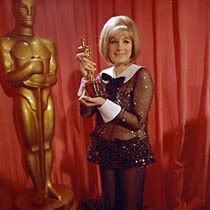
On this date in Hollywood history – April 14, 1969, the 41st annual Academy Awards are broadcast live to a television audience in 37 nations. It was the first time the awards had been televised worldwide, as well as the first Oscar ceremony to be held in the Dorothy Chandler Pavilion of the Los Angeles Music Center. Adding to the momentous nature of the night was the first Oscar tie in a major acting category in more than three decades. “It’s a tie!” Ingrid Bergman exclaimed upon opening the Best Actress envelope. The award went to both Katharine Hepburn, for her turn as Eleanor of Aquitaine in The Lion in Winter, and Barbra Streisand, for her debut performance in Funny Girl. Reprising her role in the hit Broadway musical, Streisand earned raves for her portrayal of Fanny Brice, the quintessential “ugly duckling” who blossoms into a sophisticated and beautiful star. It was the 11th Oscar nomination for Hepburn, who had won Best Actress the previous year for Guess Who’s Coming to Dinner and had not been expected to repeat. She was a no-show at the April 14th ceremony, and an emotional Streisand stole the moment, cooing “Hello, gorgeous” (her opening line in Funny Girl) upon accepting her golden Oscar. Both Streisand and Hepburn received 3,030 votes each; it was the first exact tie in a principal Oscar category. When Fredric March (Dr. Jekyll and Mr. Hyde) and Wallace Beery (The Champ) split the award for Best Actor in 1932, Beery had actually received one less vote than March. The rules at the time stated that if any nominated film or artist came within three votes of winning in a principal category, the result would be considered a tie. There have been other Oscar ties over the years, twice in the Best Documentary category (1949 and 1986) and once for Best Live Action Short Film (1986).
 
 
Michael Thomas Barry is the author of numerous books that include Fade to Black Graveside Memories of Hollywood Greats, 1929-1950 (Schiffer, 2011). The book was awarded a SILVER MEDAL at the 2011 Readers Favorite Best Books Awards, it was a FINALIST in the 2011 USA Book News Best Book Awards, WINNER of the 2013 Beverly Hills Book Awards and an HONORABLE MENTION at the 2013 Southern California Book Festival. Visit his website www.michaelthomasbarry.com for more information

His book can be purchased from Amazon through the following link:
Amazon - http://www.amazon.com/Fade-Black-Graveside-Memories-Hollywood/dp/0764337092/ref=la_B0035CPN70_1_4?s=books&ie=UTF8&qid=1397494390&sr=1-4

Wednesday, September 18, 2013

Actress Greta Garbo was born - 1905


Actress Greta Garbo was born Greta Gustafsson on September 18, 1905 in Stockholm, Sweden. She won a bathing beauty competition at age sixteen, and then appeared in several advertising campaigns. While studying at the Royal Theatre Dramatic School she was discovered by film director, Mauritz Stiller. Changing her name to Greta Garbo, she starred in Stiller's film, The Atonement of Gosta Berling (1924). After appearing in The Joyless Street (1925), she and Stiller immigrated to the United States. In Hollywood she appeared in several silent films including The Temptress (1926), Flesh and the Devil (1927) and The Mysterious Lady (1928). Despite her Swedish accent, Garbo successfully switched to talking pictures with Anna Christie (1930). This was followed by Susan Lennox, Her Fall and Rise (1931), Grand Hotel (1932), Mati Hari (1932), Queen Christina (1933), Anna Karenina (1935), Camille (1937) and Ninotchka (1939).  She nominated for four best actress Academy Awards. In 1955, she was awarded an honorary Oscar for life-time achievement but did not attend the ceremony. Garbo retired from movies after filming Two Faced Woman (1941) and remained a total recluse for the rest of her life. Greta Garbo died in New York City on April 15, 1990.
 
Michael Thomas Barry is the author of Fade to Black. The book can be purchased from Amazon through the following link:

Thursday, August 29, 2013

Actress Ingrid Bergman was born and died on this date in 1915 and 1982


Academy Award winning actress Ingrid Bergman was born on August 29, 1915 in Stockholm, Sweden and died on the same date in 1982. Educated at the Royal Dramatic Theatre School in Stockholm, she made her film debut in Branningar (1935). Bergman established herself as one of Sweden's leading stars during the middle 1930s. American producer, David O. Selznick was so impressed with her talent that he brought her to Hollywood. The Hollywood version of Intermezzo was a great success and Bergman followed this with other popular films such as Adam had Four Sons (1941), Rage in Heaven (1941), Casablanca (1942), For Whom the Bell Tolls (1943), The Bells of St. Mary’s (1945), Spellbound (1945), Notorious (1946) and Joan of Arc (1948). In August, 1949, Bergman became the center of a major scandal when it was revealed by her husband, that she had abandoned their ten year old daughter, to live with Italian film director, Roberto Rossellini. Politicians became involved in the case and one senator, Edwin Johnson of Colorado, denounced her behavior as "an assault upon the institution of marriage" and described her as a "powerful influence of evil.” Bergman was unable to work in Hollywood for seven years but made a triumphant return in Anastasia (1956) for which she won an Academy Award. Other successes were to follow that included Murder on the Orient Express (1974). Ingrid Bergman died on August 29, 1982 from breast cancer in London. Most of her cremated remains were scattered at sea off the west coast of Sweden and the rest were placed next to her parents' ashes at the Northern Cemetery, Stockholm, Sweden.
 
Michael Thomas Barry is the author of Fade to Black: Graveside Memories of Hollywood Greats, 1927-1950. The book can be purchased from Amazon through the following links:

Monday, November 12, 2012

Grace Kelly is Born - 1929

Actress Grace Kelly was born on November 12, 1929 in Philadelphia, Pennsylvania.


After embarking on an acting career in 1950, Kelly appeared in New York City theatrical productions as well as in more than forty episodes of live drama productions broadcast during the early 1950s. In October 1953, with the release of Mogambo, she became a movie star, a status confirmed in 1954 with a Golden Globe and Academy Award nomination as well as leading roles in five films, including The Country Girl, for which she won the Oscar for best actress in 1955. On April 18, 1956, Kelly married prince Rainier III of Monaco. Kelly then retired from acting at to enter upon her duties in Monaco. She and Prince Rainier had three children. Kelly died on September 14, 1982 after suffering a stroke she lost control of her automobile and crashed. Her daughter, Princess Stephanie, was in the car with her, and survived the accident. 

Michael Thomas Barry is the author of Fade to Black Graveside Memories of Hollywood Greats, 1927-1950 the book can be purchased from Amazon or Barnes & Noble through the following links–
 

Monday, July 16, 2012

Oscar Winning Actress Celeste Holm Dies at Age 95

Yesterday, July 15, 2012, one of the last remaining stars from the Golden Age of Hollywood, Celeste Holm winner of the 1947 Oscar for Best Supporting Actress died at age 95.

In the summer of 2010, I was fortunate to meet Celeste and she graciously agreed to review my 2nd book. She was candid about her love of Broadway and life on the silver screen and these kind comments will always be cherished. She preferred to be known as a stage actress and changed my words from "bright lights of Hollywood to the brighter lights of Broadway." Always polite about her fellow actors and actress, she saw Bette Davis as the consummate professional, although cold and aloof to her fellow co-stairs.

Her quote for the back of my book "Fade to Black" reads in part -

"This is an enjoyable read offering more than the interesting anecdotes and history so well described by Michael Barry, but an opportunity for loyal fans to pay their respects to those they loved and admired...and I hope others enjoy it as much as I have."

She was a true legend and beautiful actress that will be missed. With Holm's passing their are now only two living Oscar winners of the Golden Age of Hollywood, Olivia De Havilland and Luise Rainer.

Biography -


Born and raised in New York City, Holm grew up as an only child. Her mother, Jean Parke, was an American portrait artist and author; her father, Theodor Holm, was a Norwegian businessman whose company provided marine adjustment services for Lloy’d of London. Because of her parents' occupations, she traveled often during her youth and attended various schools in Holland, France and the United States. She graduated from University High School for Girls in Chicago, where she performed in many school stage productions. She then studied drama at the University of Chicago before becoming a stage actress in the late 1930s.

Holm's first professional theatrical role was in a production of Hamlet starring Leslie Howard. Her first role on Broadway was a small part in 1938 comedy Gloriana, which lasted five performances. Her first major Broadway part was as Mary L. in the 1940 revival of The Time of Your Life co-starring fellow newcomer Gene Kelly. The role that got her the most recognition from critics and audiences was Ado Annie in the flagship Broadway production of Rodgers and Hammerstein’s Oklahoma in 1943. After she starred in the Broadway production of Bloomer Girl, 20th Century Fox signed Holm to a movie contract in 1946. She made her film debut that same year in Three Little Girl’s in Blue. In 1947 she won an Oscar and Golden Globe for Best Supporting Actress in Gentlemen’s Agreement. After her performance in All About Eve, however, Holm realized she preferred live theater to movie work, and only accepted a few select film roles over the following decade.  

In 1958, she starred as a reporter in an unsold television pilot called The Celeste Holm Show, based on the book No Facilities for Women. In 1965, she played the Fairy Godmother alongside Lesley Ann Warren in the CBS production of Cinderella. In 1970-71, she was featured on the NBC sitcom Nancy, with Renne Jarrett. She last appeared on television in the CBS television series Promised Land (1996–99). Holm’s was married five times, and had two children. On April 29, 2004, her 87th birthday, Holm married opera singer Frank Basile, age 41. According to her husband, Holm had been treated for memory loss since 2002, suffered skin cancer, bleeding ulcers and a collapsed lung, and had hip replacements and pacemakers. In June 2012, Holm was admitted to New York's Roosevelt Hospital with dehydration. She suffered a heart attack on July 13 in the facility, dying at home on July 15 where she chose to spend her final days.

Tuesday, July 3, 2012

Serial Killer Martha Ann Johnson is arrested (1989) & Actor Tom Cruise is Born (1962)

On this date in 1989, Martha Ann Johnson is arrested in Georgia for the 1982 murder of her oldest child, Jennyann Wright, after an Atlanta newspaper initiated a new investigation into her suspicious death.  


Johnson's three other children had also mysteriously died between 1977 and 1982. Back in September 1977, Johnson (who was only 21 at the time) and her third husband, Earl Bowen, lived with Johnson's kids, Jennyann Wright and James Taylor, from her previous marriages. Shortly after a dispute in which Bowen walked out on Johnson, two-year-old James was brought to the hospital and pronounced dead. The doctors ruled the cause of death to be sudden infant death syndrome (SIDS). 

In the wake of the tragedy, Bowen returned home and the couple reconciled, having two additional children, Earl Jr. and Tibitha. But in 1980, after Bowen took off again, three-month-old Tibitha was found dead--reportedly the result of SIDS once again. Although Bowen was suspicious, he returned home, where he remained until another fight separated the couple. This time, little Earl was stricken with an unknown seizure disorder and died. Jennyann told social workers that she was afraid of her mother, but the authorities sent her home anyway. A year later, she was dead too--asphyxiated from an undetermined cause. 

In 1989, after she split from Bowen for good and married her fourth husband, Johnson was arrested. She quickly confessed that she had smothered Jennyann and James as they slept by sitting on them (she weighed more than 250 pounds), but denied responsibility for the other two deaths. She admitted that her motive was to reunite with Bowen. At her trial, which began in 1990, she recanted her confession, but the jury was able to watch it on videotape nevertheless. They convicted Johnson of first-degree murder. Johnson's case initiated a trend in the 1990s in which authorities looked more closely into the sudden deaths of young children. Many doctors have insisted that SIDS has been misdiagnosed in a multitude of cases. 

On this day in 1962, actor Tom Cruise is born in Syracuse, New York.


After his breakout role in the 1983 film Risky Business, Cruise went on to become one of the biggest stars in Hollywood, appearing in a long list of critically acclaimed dramas and blockbuster action movies. At age 18, Cruise made his feature film debut in Endless Love (1981), which was followed by Taps (1981) and The Outsiders (1983). He first won international fame for his role as fighter pilot Pete “Maverick” Mitchell in 1986’s Top Gun. Cruise received his first Academy Award nomination for his star turn as Vietnam vet and anti-war activist Ron Kovic in Born on the Fourth of July (1989). His second Oscar nomination for Best Actor came for his portrayal as a sports agent in Jerry Maguire (1996); a third nomination followed, in the Best Supporting Actor category, for Cruise’s performance as a self-help guru in Paul Thomas Anderson’s quirky ensemble drama Magnolia (1999). 

Cruise’s numerous film credits also include The Color of Money (1986) with Paul Newman; Rain Man (1988) with Dustin Hoffman; A Few Good Men (1992) with Jack Nicholson; The Firm (1993) and Interview with the Vampire: the Vampire Chronicles (1994). He starred as superspy Ethan Hunt in 1996’s Mission: Impossible, and reprised his role in the hit 2000 and 2006 sequels. Cruise acted in three films with Nicole Kidman, to whom he was married from 1990 to 2001: Days of Thunder (1990), Far and Away (1992) and Eyes Wide Shut (1999). Other Cruise movies include Minority Report (2002) and War of the Worlds (2005), both of which were directed by Steven Spielberg. 

In the spring of 2005, Cruise and actress Katie Holmes, who co-starred in the television drama Dawson’s Creek (1998-2003), embarked on a whirlwind, high-profile romance. That May, Cruise went on The Oprah Winfrey Show and generated headlines by jumping on the host’s couch and expressing his love for Holmes, who is 16 years, his junior. The following month, the two actors were engaged in Paris. Around the same time, Cruise sparked controversy for his impassioned advocacy of Scientology and his criticism of anti-depressant drugs and psychiatry. On November 18, 2006, following the birth of their daughter Suri in April of that same year, Cruise and Holmes were wed in Italy, an event that received huge media coverage. In May 2008, Cruise returned to The Oprah Winfrey Show for a retrospective of his 25 years in film, beginning with his breakout in Risky Business. This past week Katie Holmes filed for divorce with Scientology being the rumored reason for the split.  

Friday, June 29, 2012

Jayne Mansfield is Killed in Car Crash (1967) & Katharine Hepburn Dies (2003)

On this date in 1967, Blonde bombshell actress Jayne Mansfield is killed when the car in which she is riding strikes the rear of a trailer truck on Interstate-90 east of New Orleans, Louisiana.


Mansfield had been on her way to New Orleans from Biloxi, Mississippi, where she had been performing a standing engagement at a local nightclub; she had a television appearance scheduled the following day. Ronald B. Harrison, a driver for the Gus Stevens Dinner Club, was driving Mansfield and her lawyer and companion, Samuel S. Brody, along with three of Mansfield's children with her ex-husband Mickey Hargitay, in Stevens' 1966 Buick Electra. On a dark stretch of road, just as the truck was approaching a machine emitting a thick white fog used to spray mosquitoes (which may have obscured it from Harrison's view), the Electra hit the trailer-truck from behind. Mansfield, Harrison and Brody were all killed in the accident. Eight-year-old Mickey, six-year-old Zoltan and three-year-old Marie, or Mariska, had apparently been sleeping on the rear seat; they were injured but survived. 

Born Vera Jayne Palmer in Bryn Mawr, Pennsylvania, Mansfield arrived in Hollywood as a young wife and mother (to daughter Jayne Marie) in 1954, determined to become an actress. From the beginning, she wasn't afraid to make the most of her assets, particularly her curvaceous figure, flowing platinum blonde hair and dazzling smile. Cast in the Broadway comedy "Will Success Spoil Rock Hunter?", she turned heads as a voluptuous, dumb blonde movie star; in one famous scene she appeared in nothing but a white towel. She famously appeared nude in the 1963 comedy "Promises! Promises!", and stills from the set appeared in Playboy magazine, but her best performance was generally believed to have been in 1957's "The Wayward Bus," based on the John Steinbeck novel and costarring Joan Collins. While her screen career amounted to about a dozen less-than-memorable films, off screen she played the movie star role to perfection, and became one of the most visible glamour girls of the era. In 1958, after her first marriage ended in divorce, she married Hargitay, a former Mr. Universe; they divorced in 1963, and Mansfield was married once more, to Matt Climber, in 1964. That marriage also ended in divorce and she was awarded custody of their child, Octabiano. Mariska Hargitay, injured in the accident that killed her mother, later launched her own acting career, most memorably starring in the long-running television drama "Law & Order: Special Victims Unit."

On this date in 2003, Katharine Hepburn, a four-time Academy Award winner for Best Actress and one of the greatest screen legends of Hollywood’s golden era, dies of natural causes at the age of 96, at her home in Old Saybrook, Connecticut.


Hepburn was born into a well-to-do New England family, the daughter of a prominent surgeon, Dr. Thomas Norval Hepburn, and his wife, Katharine Houghton, a suffragist and birth control advocate. She graduated from Bryn Mawr College in Pennsylvania in 1928 and became a stage actress; her role in the 1932 Broadway production The Warrior’s Husband led to a Hollywood screen test and a contract with RKO studios. In Hepburn’s debut film, A Bill of Divorcement (1932), she starred opposite John Barrymore and was directed by George Cukor, who would become her close friend and helm many of her films (including 1933’s Little Women, 1935’s Sylvia Scarlett, 1938’s Holiday and 1949’s Adam’s Rib). 

Heralded as a fresh, unconventional beauty and a talented actress, Hepburn won her first Best Actress Oscar for only her third film, Morning Glory (1933). A string of films made with RKO had mixed degrees of success, and Hepburn began earning a reputation as arrogant and self-absorbed on set, though she was always meticulously prepared for her roles. She also refused to play by the rules governing typical Hollywood starlets at the time, appearing publicly in pantsuits and without makeup and refusing to sign autographs or grant interviews. After modest successes with Stage Door (1937) and Bringing Up Baby (1938), Hepburn decided to buy out her contract with RKO, a move that gave her unusual control over her career for that time. Her faltering image was revived by the success of The Philadelphia Story, which had originally been written for Hepburn to play on Broadway and was then adapted into a hit 1940 movie co-starring Cary Grant and Jimmy Stewart. Several years later, Hepburn met the actor Spencer Tracy while co-starring with him in Woman of the Year (1942). Though Tracy, a devout Catholic, remained married, the two began a romantic relationship that would last until Tracy’s death nearly three decades later (Hepburn had divorced her husband of six years, Ludlow Ogden Smith, in 1934). On-screen, they acted in nine films together, including Adam’s Rib (1949), Pat and Mike (1952) and Guess Who’s Coming to Dinner (1967). Tracy died just weeks after shooting was completed on the last film, for which Hepburn would win her second Best Actress Oscar. 

Hepburn was awarded her third Oscar for her starring turn in A Lion in Winter (1968). She continued to appear in films and on television (including an Emmy-winning performance in 1976’s Love Among the Ruins) throughout the next three decades, winning a fourth Best Actress statuette for 1981’s On Golden Pond. Nominated for 12 Academy Awards in her lifetime (a record that would stand until 2003, when Meryl Streep received her 13th nomination), Hepburn never attended the awards show to collect her honors in person. In 1986, she broke her longtime silence about her relationship with Tracy (his widow had died in 1983) in a televised tribute to the actor. She read aloud a poignant letter she had written to him about his drinking and about their last years together. She later included the letter in her best-selling 1991 autobiography Me: Stories of My Life. In her final screen appearance, in 1994’s Love Affair (a remake of the classic 1939 film), Hepburn appeared frail but composed as ever in her portrayal of the aristocratic aunt of Warren Beatty’s character. In 1999, the American Film Institute (AFI) named Hepburn as the greatest female actress in the history of American cinema. When she died on June 29, 2003, the lights on Broadway were dimmed for an hour to mark the passing of one of entertainment’s brightest stars.

Friday, June 15, 2012

Judy Garland Marries Vincente Minnelli - 1945

On this date in 1945, the 23-year-old actress and singer Judy Garland marries director Vincente Minnelli, her second husband.  


Garland was born Frances Gumm in 1922, in Grand Rapids, Minnesota. Her parents ran a movie theater, and at age three Frances joined her two older sisters in a vaudeville act called The Gumm Sisters that performed before the movie presentation. Her mother later took them on the vaudeville circuit, where they were eventually renamed The Garland Sisters. Although the girls weren’t especially well received as a vaudeville act, Frances--now known as Judy Garland--drew the attention of Metro-Goldwyn-Mayer (MGM)’s production head, Louis B. Mayer. He signed her to a contract when she was 13 years old. Two years later, she made the first of her nine films with Mickey Rooney. Garland became a star in 1939 with The Wizard of Oz, in which she played Dorothy, a role originally intended for Shirley Temple. In the film, she performed the plaintive ballad “Somewhere Over the Rainbow,” which would become one of her signature songs. Garland also delighted audiences in other movie musicals, including Strike Up the Band (1941), For Me and My Gal (1942) and Meet Me in St. Louis (1944). 

In 1941, at the age of 19, Garland married the bandleader David Rose, but the marriage broke up in 1945. She met Minnelli, who was also married at the time, when he directed her in Meet Me in St. Louis. Minnelli was born in Chicago in 1903 and, like Garland, entered show business while a toddler, performing in a family act. He dropped out of school at 16 and became a costume designer and stage manager for the live acts that preceded films shown at a Chicago theater chain. He later moved to New York, eventually becoming an art director at Radio City Music Hall. He began directing Broadway musicals in 1935, and moved to Hollywood in 1940, when MGM hired him as a film director. While they were married, Garland and Minnelli worked together on The Clock (1945) and The Pirate (1948). Their daughter, Liza, was born in 1946, and the marriage lasted until 1951. Minnelli went on to direct Oscar-winning films that included An American in Paris (1951), Band Wagon (1953) and Gigi. He also directed Father of the Bride (1950). Garland had used amphetamines and sleeping pills since adolescence, and her dependence on drugs and alcohol eventually undermined her career and led to several nervous breakdowns and suicide attempts. Her third husband, Sid Luft, managed her comeback in the early 1950s, booking her in triumphant live engagements in London and New York. Garland won an Academy Award nomination for Best Actress for A Star Is Born (1954), but her downward spiral resumed in the 1960s, and she died of an overdose of sleeping pills on June 22, 1969, at the age of 47.

Monday, June 11, 2012

Escape from Alcatraz (1962) and John Wayne dies (1979)

On this date in 1962, John and Clarence Anglin and Frank Lee Morris attempt to escape from Alcatraz federal prison.


The three men were never seen again, and although some believe that theirs was the only successful getaway from what was known as "The Rock," it is far more likely that they drowned in the chilly water. Four days after their escape, a bag containing photos, which belonged to Clarence Anglin, was found in San Francisco Bay. Escape From Alcatraz, both a J. Campbell Bruce book and a Clint Eastwood movie, later dramatized the incident. The three prisoners began their daring escape by using stolen tools to chip away at the cement near ventilation holes in their cells. Creatively, they then made fake grills out of cardboard and painted them to match the originals, which were located in a small area where they could get outside without being seen. In a classic maneuver, the inmates made dummy heads and placed them in their beds so that the guards would not notice them missing. They even used scraps of hair from the barbershop to make them look more realistic. Once outside, the three climbed over a 15-foot fence and made their way out to the choppy waters surrounding the island prison with life preservers made out of raincoats. Over the years in which Alcatraz was used as a prison, 36 inmates (in 14 separate attempts) tried to escape. One drowned; six were shot to death; and five were never found, but were assumed to have drowned, including the Anglins and Morris. The remaining were captured, including two who were executed after one man, Bernard Coy, jumped a guard and got his gun in May 1946. With the help of others, Coy captured nine guards. However, the ensuing showdown left two guards and three inmates dead, and no one got off the island.


 On this day in 1979, John Wayne dies at age 72 after battling cancer for more than a decade.

Thursday, June 7, 2012

Jean Harlow Dies - 1937

On this day in 1937, actress Jean Harlow dies from kidney failure at the age of 26.


Born Harlean Carpenter in Kansas City, Missouri, she moved with her mother to Los Angeles as a child after her parents separated. Harlean was an amalgam of her mother’s maiden name, Jean Harlow, which the actress later took as her stage name. At the age of 16, she eloped with Charles McGrew, a young bond broker. Their marriage ended after she decided to pursue an acting career, against the will of her husband.  

After working as a film extra, Harlow signed a contract with the producer Hal Roach, under which she briefly but memorably bared her soon-to-be-famous legs in Double Whoopee (1929), a Laurel and Hardy comedy. She made her sound debut in The Saturday Night Kid (1929), starring Clara Bow. Harlow got her big break soon after that, when Howard Hughes cast her in the sound update of his silent World War I era epic Hell’s Angels (1930). In that film, Harlow made an impression on audiences with her glowing white-blond hair and the suggestive line “Would you be shocked if I put on something more comfortable?” 

Harlow appeared in a string of films in 1931, including The Secret Six, The Public Enemy, Goldie and Platinum Blonde. Her roles in these movies, as in Hell’s Angels, relied less on her acting and more on her alluring appearance. After Metro-Goldwyn-Mayer bought Harlow’s contract from Hughes in 1932, she made her breakout appearance in Red-Headed Woman (1932), for which screenwriter Anita Loos created a part especially for Harlow. The film was the first to showcase her comedic talent as well as her bombshell looks. Harlow’s popularity with fans and film critics alike continued to grow throughout the next several years, thanks to smash hits like Red Dust (1932)--one of her numerous movies with Clark Gable--Dinner at Eight (1933), Hold Your Man (1933) and Bombshell (1933). 

Aside from her meteoric rise to fame in her professional life, Harlow’s private life was marked by grief and tragedy. Her second husband, Paul Bern (an executive at MGM), died by an apparent suicide in 1932. Harlow’s third marriage, to cinematographer Harold Rosson, lasted less than a year. Harlow was engaged to marry the actor William Powell, her co-star in Reckless (1935) and Libeled Lady (1936), when she suddenly became seriously ill in late May 1937. According to her obituary in the New York Times, the actress had suffered from poor health for a year, including “an acute case of sunburn,” a throat infection and influenza. She also contracted scarlet fever and meningitis as a teenager, which permanently weakened her health. After doctors diagnosed uremic poisoning the weekend before, according to the Times, “Miss Harlow soon responded favorably to treatment and was thought well on the road to recovery when she lapsed into a coma last night.” She died the next day, June 7, 1937, at a hospital in Hollywood, California. Powell was at Harlow’s bedside when she died, along with her mother, stepfather and cousin. Harlow’s final film, Saratoga (1937), was released posthumously; another actress served as her stand-in for several scenes so that the movie could be completed.

Monday, June 4, 2012

Angelina Jolie is Born - 1975

On this day in 1975, the Academy Award-winning actress Angelina Jolie (Voight) is born in Los Angeles, California.


 Jolie’s father, actor Jon Voight, had been nominated for a Best Actor Oscar for Midnight Cowboy (1969); he won the award for Coming Home (1978). Her mother, Marcheline Bertrand, was also an actress; the couple divorced when Angelina was still an infant. As a young girl, Jolie worked as a model and appeared with her father in the 1982 film Lookin’ to Get Out. She later studied acting at the famed Lee Strasberg Theatre Institute and New York University. After appearing in a small role in Cyborg 2 (1993), Jolie landed a sizeable part in the better-known Hackers (1995), which co-starred the British actor Jonny Lee Miller. Jolie and Miller married that year but split in 1997 and later divorced. 

After a string of forgettable films, Jolie was nominated for an Emmy and won a Golden Globe for her role as the wife of the segregationist Alabama governor, in the television movie George Wallace. She earned another Emmy nod the following year for her portrayal of the troubled bisexual model Gia Carangi in the TV biopic Gia. Suddenly very much in demand, Jolie landed roles in higher-profile big-screen projects such as Playing By Heart (1998), Pushing Tin (1999) and The Bone Collector (1999). It was Jolie’s mesmerizing turn as the charismatic sociopath Lisa in Girl, Interrupted, however, that catapulted her to A-list Hollywood stardom. She won an Academy Award for Best Supporting Actress for the role, and characteristically raised eyebrows by locking lips with her older brother, James Haven, at the 2000 Oscar ceremony. That May, Jolie again generated a flurry of headlines when she wed Billy Bob Thornton, her much older, four-times-married co-star in Pushing Tin (1999), in a quickie ceremony in Las Vegas. Later in 2000, Jolie starred in the fast-paced hit Gone in Sixty Seconds and the thriller Original Sin. During a brief reconciliation with her father, the two appeared together in Lara Croft: Tomb Raider (2001), a blockbuster action film in which Jolie performed the majority of her own stunts. Despite poor reviews, Tomb Raider and its 2003 sequel were both huge box-office hits. Less successful was the romantic comedy-drama Life or Something Like It (2002). 

The press painted a vivid picture of Jolie and Thornton’s eccentric devotion to each other, including the fact that they wore vials of each other’s blood around their necks. Still, Jolie filed for divorce in mid-2002. By that time, she had been appointed a goodwill ambassador by the United Nations, having first made goodwill trips while researching her role as an aid worker in 2003’ Beyond Borders. She also adopted a son, Maddox, from Cambodia. In April 2004, Jolie began filming Mr. & Mrs. Smith, in which she and Brad Pitt played a married couple who are secretly both hired assassins. Rumors soon began flying about their off-screen romantic involvement, and only intensified after Pitt and his wife Jennifer Aniston announced their separation in January 2005. Two months after his divorce from Aniston was finalized, Pitt petitioned to adopt Maddox and Jolie’s daughter Zahara (adopted in June 2005 in Ethiopia). In January 2006, during a visit to the Dominican Republic, the now-official couple--dubbed “Brangelina” by the press--announced that Jolie was pregnant. Shiloh Nouvel Jolie-Pitt was born that May in Namibia. Jolie adopted another son, Pax Thien, from an orphanage in Vietnam in March 2007; she gave birth to twins, Knox Leon and Vivienne Marcheline, in France in July 2008. Though her film career often seemed to take a backseat in the headlines to her globetrotting lifestyle and ever-expanding family (not to mention her romance with the equally photogenic Pitt), Jolie continued to work steadily in films, notably in the spy drama The Good Shepherd (2006) and A Mighty Heart (2007), in which she played Mariane Pearl, the wife of a Wall Street Journal reporter who was killed by terrorists in Pakistan in 2002. In 2008, she starred in the summer action film Wanted and the crime drama Changeling, directed by Clint Eastwood.

Friday, June 1, 2012

Marilyn Monroe was Born - 1926

On this date in 1926, Marilyn Monroe is born in Los Angeles, California.


She was born Norma Jeane Mortenson but later be given her mother’s name, and baptized Norma Jeane Baker. But she  become better known around the world as the glamorous actress and sex symbol Marilyn Monroe.  After a tumultuous childhood that saw both maternal grandparents and her mother committed to mental institutions, young Norma Jeane lived with a string of foster families. She married one of her neighbors, James Dougherty, when she was 16.  A photographer “discovered” the naturally photogenic Norma Jeane while she was working in a California munitions factory, and she was soon launched into a successful modeling career. She divorced Dougherty in June 1946 and soon after signed a film contract with 20th Century Fox. 

At the outset of her acting career, Norma Jeane dyed her brown hair blonde and changed her name again, calling herself Marilyn Monroe (Monroe was her grandmother’s last name). After a bit part in 1947’s The Shocking Miss Pilgrim, she had a string of forgettable roles before landing a spot in John Huston’s thriller The Asphalt Jungle (1950). That same year, she also drew attention for her work in All About Eve, starring Bette Davis. Her true breakout performance, however, came in Niagara (1953), a thriller in which Monroe played an adulterous young wife who plots with her lover to kill her husband.

After starring in Gentleman Prefer Blondes and How to Marry a Millionaire in 1953, Monroe was at the top of Hollywood’s A-list. In January 1954, she married baseball great Joe DiMaggio at San Francisco City Hall. Though the press hailed their relationship as the quintessential All-American love affair, trouble began brewing almost immediately. DiMaggio was notoriously uncomfortable with his new wife’s sexy public image, and her popularity, as evidenced by the near-riot among U.S. servicemen stationed in Korea during a performance she gave in the middle of the couple’s honeymoon. They would divorce that October, after only nine months of marriage, but remained good friends.  

Monroe attempted to switch to more serious acting roles, studying at the prestigious Actors’ Studio in New York. She earned positive reviews for her more nuanced work in Bus Stop (1956), The Prince and the Showgirl (1957) and particularly Some Like It Hot (1959). By 1961, however, trouble in Monroe’s personal life began to develop, her third marriage, to the acclaimed playwright Arthur Miller, dissolved after four years and Marilyn was left in an ever increasingly emotional state of mind, and that year she was admitted on two occasions to hospitals for psychiatric observation and rest. Her final film was The Misfits (1961), written by Miller and co-starring Montgomery Clift and Clark Gable (it would also be Gable’s final appearance on-screen.) In June 1962, Fox dismissed the actress after repeated and extended absences from the set of Something’s Got to Give. On August 5, 1962, Monroe was found dead from an overdose of barbiturates in her home in Brentwood, California. She was 36 years old.


Michael Thomas Barry is the author of numerous books that includes Fade to Black Graveside Memories of Hollywood Greats, 1927-1950. The book was awarded a silver medal at the 2011 Readers Favorite International Book Awards and was the winner of the 2013 Beverly Hills Book Awards. The book can be purchased from Amazon through the following link:

Amazon - http://www.amazon.com/Fade-Black-Graveside-Memories-Hollywood/dp/0764337092/ref=la_B0035CPN70_1_5?s=books&ie=UTF8&qid=1400077263&sr=1-5
 

Thursday, May 31, 2012

Clint Eastwood is Born - 1930

On this date in 1930, Clint Eastwood is born in San Francisco, California.


With his father, Eastwood wandered the West Coast as a boy during the Depression. Then, after four years in the Army Special Services, Eastwood went to Hollywood, where he got his start in a string of B-movies. For eight years, Eastwood played Rowdy Yates in the popular TV Western series Rawhide, before emerging as a leading man in a string of low-budget “spaghetti” Westerns directed by Sergio Leone: Fistful of Dollars (1964), For a Few Dollars More (1965) and The Good, the Bad and the Ugly (1966). All three were successful, but Eastwood made his real breakthrough with 1971’s smash hit Dirty Harry, directed by Don Siegel. Though he was not the first choice to play the film’s title role--Frank Sinatra, Steve McQueen and Paul Newman all reportedly declined the part, Eastwood made it his own, turning the blunt, cynical Dirty Harry into an iconic figure in American film. 

Also in 1971, Eastwood moved behind the camera, making his directorial debut with the thriller Play Misty for Me, the first offering from his production company, Malpaso. Over the next two decades, he turned in solid performances in films such as The Outlaw Josey Wales (1976), Every Which Way But Loose (1978), Escape From Alcatraz (1979) and Honkytonk Man (1982), but seemed to be losing his star power for lack of a truly great film. By the end of the 1980s, after four Dirty Harry sequels, released from 1973 to 1988, Eastwood was poised to escape the character’s shadow and emerge as one of Hollywood’s most successful actor-turned-directors. In 1992, he hit the jackpot when he starred in, directed and produced the darkly unconventional Western Unforgiven. The film won four Oscars, including Best Supporting Actor (Gene Hackman), Best Film Editing, Best Director and Best Picture, both for Eastwood. He also found box-office success as a late-in-life action and romantic hero, in In the Line of Fire (1993) and The Bridges of Madison County (1995), respectively. 

As a director, Eastwood worked steadily over the next decade, making such films as Midnight in the Garden of Good and Evil (1997), Absolute Power (1997) and, most notably, the crime drama Mystic River (2003), for which he was again nominated for the Best Director Oscar. The following year, he hit a grand slam with Million Dollar Baby, in which he also starred as the curmudgeonly coach of a determined young female boxer (Hilary Swank, in her second Oscar-winning performance). In addition to Swank’s Academy Award for Best Actress, the film won Oscars for Best Supporting Actor (Morgan Freeman) and Eastwood’s second set of statuettes for Best Director and Best Picture. 

In 2006, Eastwood became only the 31st filmmaker in 70 years to receive a Lifetime Achievement Award from the Directors Guild of America (DGA). That year, he directed a pair of World War II themed movies, Flags of Our Fathers (2006) and Letters from Iwo Jima (2006). The latter film, which featured an almost exclusively Japanese cast, earned an Oscar nomination for Best Picture and a fourth Best Director nomination for Eastwood (his 10th nomination overall). Off-screen, Eastwood has pursued an interest in politics, serving as mayor of Carmel, California, from 1986 to 1988. He was married to Maggie Johnson in 1953, and the couple had two children, Kyle and Alison (who co-starred in Midnight in the Garden of Good and Evil), before separating in 1978 and divorcing in 1984. Eastwood also had long-term relationships with the actresses Sondra Locke and Frances Fisher (with whom he had a daughter, Francesca). He married his second wife, Dina Ruiz Eastwood, in 1996. Their daughter, Morgan, was born that same year.

Tuesday, May 29, 2012

Bob Hope is Born - 1903


On this date in 1903, actor/ comedienne Bob Hope is born.


One of the leading talents on the vaudeville scene by the 1930s, the London-born, American-raised Hope met his future wife (of nearly seven decades), the nightclub singer Dolores Reade, while he was performing on Broadway in the musical Roberta. They married in 1934, and four years later Hope launched his own radio program, The Bob Hope Show, which would run for the next 18 years. One of the country’s most popular comics, Hope had a successful film career largely thanks to the series of seven “Road” movies he made with Bing Crosby and Dorothy Lamour, including Road to Singapore (1940), Road to Morocco (1942), Road to Utopia (1946) and Road to Rio (1947). In 1941, after America’s entrance into World War II, Hope began performing for U.S. troops abroad; he would play shows for more than a million American servicemen by 1953. Some 65 million people watched him perform for troops in Vietnam on Christmas Eve in 1966, in his largest broadcast. Hope also became a legend for his countless TV specials, which he would perform over the course of some five decades. He hosted the Academy Awards ceremony a total of 18 times, more than any other Oscar host. Dubbed “Mr. Entertainment” and the “King of Comedy,” Hope died on July 27, 2003, less than two months after his 100th birthday celebration.

Saturday, May 26, 2012

John Wayne is Born - 1907

On this date in 1907, John Wayne, an actor who came to epitomize the American West, is born in Winterset, Iowa.  


Born Marion Michael Morrison, Wayne's family moved to Glendale, California, when he was six years old. As a teen, he rose at four in the morning to deliver newspapers, and after school he played football and made deliveries for local stores. When he graduated from high school, he hoped to attend the U.S. Naval Academy. However, after the school rejected him, he accepted a full scholarship to play football at the University of Southern California in Los Angeles. 

In the summer of 1926, Wayne's football coach found him a job as an assistant prop man on the set of a movie directed by John Ford. Ford started to use Wayne as an extra, and he eventually began to trust him with some larger roles. In 1930, Ford recommended Wayne for Fox's epic Western The Big Trail. Wayne won the part, but the movie did poorly, and Fox let his contract lapse. During the next decade, Wayne worked tirelessly in countless low-budget western films, sharpening his talents and developing a distinct persona for his cowboy characters. Finally, his old mentor John Ford gave Wayne his big break, casting him in his brilliant 1939 western, Stagecoach. Wayne played the role of Ringo Kid, and he imbued the character with the essential traits that would inform nearly all of his subsequent screen roles: a tough and clear-eyed honesty, unquestioning valor, and a laconic, almost plodding manner.

After Stagecoach, Wayne's career took off. Among the dozens of Westerns he appeared in—many of them directed by Ford-were memorable classics like Tall in the Saddle (1944), Red River (1948), Fort Apache (1948), She Wore a Yellow Ribbon (1949), Rio Bravo (1959), and The Man Who Shot Liberty Valance (1962). In all these films, Wayne embodied the simple, and perhaps simplistic, cowboy values of decency, honesty, and integrity. Besides Westerns, Wayne also acted in war films. It was a small leap from the valorous cowboy or cavalry soldier to the brave WWII fighters of films like Sands of Iwo Jima (1949) and Flying Leathernecks (1951). Deeply conservative in his politics, Wayne also used his 1968 film, The Green Berets, to express his support of the American government's war in Vietnam. 

By the late 1960s, some Americans had tired of Wayne and his simplistically masculine and patriotic characters. Increasingly, western movies were rejecting the simple black-and-white moral codes championed by Wayne and replacing them with a more complex and tragic view of the American West. However, Wayne proved more adaptable than many expected. In his Oscar-winning role in True Grit (1969), he began to escape the narrow confines of his own good-guy image. His final film, The Shootist (1976), won over even his most severe critics. Wayne—who was himself battling lung cancer—played a dying gunfighter whose moral codes and principles no longer fit in a changing world. Three years later, Wayne died of cancer. To this day, public polls identify him as one of the most popular actors of all time.

Friday, May 25, 2012

Star Wars is Released - 1977

On this date in 1977, 20th Century Fox releases George Lucas' space odyssey Star Wars. 


After Lucas' second feature film, American Graffiti (1973), became a hit, Fox agreed to put up $9.5 million for the writer-director's next project. After four years in production, including location shots in Tunisia and Death Valley, California, Star Wars was ready for its release. Its relatively unknown cast featured Mark Hamill as Luke Skywalker, who teams with the roguish Han Solo (Harrison Ford) to rescue Princess Leia (Carrie Fisher) from captivity on a space station commanded by the menacing Darth Vader (voiced by James Earl Jones). The alien creatures, massive space station, elaborate space battles and other special effects came courtesy of Lucas' company, Industrial Light and Magic. 

Though Fox released Star Wars in only 42 theaters, it primed its target audience of science-fiction fans with a massive publicity campaign. By the end of its first week, the film had made $3 million, and by the end of the summer it would rake in some $100 million. Adjusting for inflation, its box-office haul was second only to Gone with the Wind. In addition to its commercial success, Star Wars was well received by critics and was nominated for 10 Academy Awards, including Best Picture. It won in six categories, mostly technical, and received an additional Oscar for Special Achievement in Sound Editing.

The success of Star Wars was credited with reviving the science-fiction film genre, which had previously been considered highly unprofitable, and--along with Steven Spielberg's 1975 hit Jaws--with introducing the concept of the summer blockbuster. It also sparked a Hollywood trend away from smaller films and toward big-budget action movies targeted at young audiences. Lucas would follow up on the success of his hit movie with two sequels, The Empire Strikes Back (1980) and Return of the Jedi (1983), fueling a huge marketing juggernaut that included clothing, toys, videos and other merchandise. The popularity of the Star Wars franchise lasted well into the 1990s, and was encouraged by a theatrical re-release of the trilogy in 1997. 

Starting in the late 1990s, Lucas released a new series of Star Wars movies, set in a time period before the original trilogy and featuring a new, younger cast (notably Ewan McGregor, Natalie Portman and Hayden Christensen) and an updated arsenal of special-effects technology. Though the three newer films--Stars Wars: Episode I - The Phantom Menace (1999), Star Wars: Episode II - Attack of the Clones (2002), and Star Wars: Episode III - Revenge of the Sith (2005)--were all huge-box office hits, they failed to match the critical acclaim garnered by the original series.

Wednesday, May 16, 2012

1st Academy Awards Ceremony is Held - 1929

On this day in 1929, the Academy of Motion Picture Arts and Sciences hands out its first awards, at a dinner party for around 250 people held in the Blossom Room of the Roosevelt Hotel in Hollywood, California. The brainchild of Louis B. Mayer, head of the powerful MGM film studio, the Academy was organized in May 1927 as a non-profit organization dedicated to the advancement and improvement of the film industry. Its first president and the host of the May 1929 ceremony was the actor Douglas Fairbanks, Sr. Unlike today, the winners of the first Oscars--as the coveted gold-plated statuettes later became known--were announced before the awards ceremony itself. 


At the time of the first Oscar ceremony, sound had just been introduced into film. The Warner Bros. movie The Jazz Singer--one of the first "talkies"--was not allowed to compete for Best Picture because the Academy decided it was unfair to let movies with sound compete with silent films. The first official Best Picture winner (and the only silent film to win Best Picture) was Wings, directed by William Wellman. The most expensive movie of its time, with a budget of $2 million, the movie told the story of two World War I pilots who fall for the same woman. Another film, F.W. Murnau's epic Sunrise, was considered a dual winner for the best film of the year. German actor Emil Jannings won the Best Actor honor for his roles in The Last Command and The Way of All Flesh, while 22-year-old Janet Gaynor was the only female winner. After receiving three out of the five Best Actress nods, she won for all three roles, in Seventh Heaven, Street Angel and Sunrise. 

A special honorary award was presented to Charlie Chaplin. Originally a nominee for Best Actor, Best Writer and Best Comedy Director for The Circus, Chaplin was removed from these categories so he could receive the special award, a change that some attributed to his unpopularity in Hollywood. It was the last Oscar the Hollywood maverick would receive until another honorary award in 1971. The Academy officially began using the nickname Oscar for its awards in 1939; a popular but unconfirmed story about the source of the name holds that Academy executive director Margaret Herrick remarked that the statuette looked like her Uncle Oscar. Since 1942, the results of the secret ballot voting have been announced during the live-broadcast Academy Awards ceremony using the sealed-envelope system. The suspense--not to mention the red-carpet arrival of nominees and other stars wearing their most beautiful or outrageous evening wear--continues to draw international attention to the film industry's biggest night of the year.