Showing posts with label Katharine Hepburn. Show all posts

Wednesday, December 10, 2014

"Guess Who's Coming to Dinner" Opened in Theaters - December 12, 1967


This week (December 10-16) in Hollywood history – Victor McLaglen was born (December 10, 1886); Douglas Fairbanks Sr. died (December 12, 1939); Guess Who’s Coming to Dinner opened in theaters (December 12, 1967); Frank Sinatra was born (December 12, 1915); Anne Baxter died (December 12, 1985); Dick Van Dyke was born (December 13, 1925); Christopher Plummer was born (December 13, 1929); Myrna Loy died (December 14, 1993); Walt Disney died (December 15, 1966); Charlie Chaplin began his movie career (December 16, 1913).

Highlighted Story of the Week –

On December 12, 1967, Guess Who’s Coming to Dinner, starring Katharine Hepburn, Spencer Tracy, Sidney Poitier and Katharine Houghton, opened in theaters. The film followed the story of a young white woman (Houghton) who brings her fiancĂ© (Poitier), an African-American doctor, home to meet her parents, played by Hepburn and Tracy in their last film together. Off-screen, the couple had a long romance, although Tracy was married to another woman. He died on June 10, 1967, a short time after the movie wrapped. Directed by Stanley Kramer, who was known for other films such as Inherit the Wind and Judgment at Nuremberg; Guess Who’s Coming to Dinner examined the reactions of the young couple’s various family members and friends to their taboo relationship. The film was nominated for 10 Academy Awards, including Best Picture, and collected two Oscars, including Best Actress for Hepburn, the second of her career.

Hepburn (1907-2003) won four Academy Awards (out of 12 total nominations) over the course of her long career. The legendary screen star followed her Oscar win for Guess Who’s Coming to Dinner with Best Actress wins for The Lion in Winter (1968) and On Golden Pond (1981). Her final feature film was 1994’s Love Affair, with Warren Beatty and Annette Bening.

Sidney Poitier, earned a Best Actor Oscar nomination for 1958’s The Defiant Ones, directed by Stanley Kramer and co-starring Tony Curtis and Theodore Bikel. For his performance as a handyman who builds a chapel for a group of German nuns in 1963’s Lilies of the Field, he became the first black man ever to win an Academy Award for Best Actor. Among Poitier’s other well-known films are To Sir, With Love (1967) and In the Heat of the Night (1967).

Spencer Tracy (1900-1967) took home his first Best Actor Oscar for 1937’s Captains Courageous, having been previously nominated in the category for 1936’s San Francisco. He won again for 1938’s Boys Town and went on to earn five other nominations. Tracy received his ninth and final Best Actor Oscar nomination for Guess Who’s Coming to Dinner.

Check back every Wednesday for a new installment of “This Week in Hollywood History.”
 
 
Michael Thomas Barry is the author of six nonfiction book that include the award winning Fade to Black: Graveside Memories of Hollywood Greats, 1927-1950. Visit Michael’s website www.michaelthomasbarry.com for more information. His book can be purchased from Amazon through the following link: 

Monday, April 14, 2014

It's a tie - Katharine Hepburn and Barbra Streisand Win Best Actress Oscars - 1969


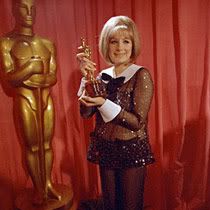
On this date in Hollywood history – April 14, 1969, the 41st annual Academy Awards are broadcast live to a television audience in 37 nations. It was the first time the awards had been televised worldwide, as well as the first Oscar ceremony to be held in the Dorothy Chandler Pavilion of the Los Angeles Music Center. Adding to the momentous nature of the night was the first Oscar tie in a major acting category in more than three decades. “It’s a tie!” Ingrid Bergman exclaimed upon opening the Best Actress envelope. The award went to both Katharine Hepburn, for her turn as Eleanor of Aquitaine in The Lion in Winter, and Barbra Streisand, for her debut performance in Funny Girl. Reprising her role in the hit Broadway musical, Streisand earned raves for her portrayal of Fanny Brice, the quintessential “ugly duckling” who blossoms into a sophisticated and beautiful star. It was the 11th Oscar nomination for Hepburn, who had won Best Actress the previous year for Guess Who’s Coming to Dinner and had not been expected to repeat. She was a no-show at the April 14th ceremony, and an emotional Streisand stole the moment, cooing “Hello, gorgeous” (her opening line in Funny Girl) upon accepting her golden Oscar. Both Streisand and Hepburn received 3,030 votes each; it was the first exact tie in a principal Oscar category. When Fredric March (Dr. Jekyll and Mr. Hyde) and Wallace Beery (The Champ) split the award for Best Actor in 1932, Beery had actually received one less vote than March. The rules at the time stated that if any nominated film or artist came within three votes of winning in a principal category, the result would be considered a tie. There have been other Oscar ties over the years, twice in the Best Documentary category (1949 and 1986) and once for Best Live Action Short Film (1986).
 
 
Michael Thomas Barry is the author of numerous books that include Fade to Black Graveside Memories of Hollywood Greats, 1929-1950 (Schiffer, 2011). The book was awarded a SILVER MEDAL at the 2011 Readers Favorite Best Books Awards, it was a FINALIST in the 2011 USA Book News Best Book Awards, WINNER of the 2013 Beverly Hills Book Awards and an HONORABLE MENTION at the 2013 Southern California Book Festival. Visit his website www.michaelthomasbarry.com for more information

His book can be purchased from Amazon through the following link:
Amazon - http://www.amazon.com/Fade-Black-Graveside-Memories-Hollywood/dp/0764337092/ref=la_B0035CPN70_1_4?s=books&ie=UTF8&qid=1397494390&sr=1-4

Friday, June 29, 2012

Jayne Mansfield is Killed in Car Crash (1967) & Katharine Hepburn Dies (2003)

On this date in 1967, Blonde bombshell actress Jayne Mansfield is killed when the car in which she is riding strikes the rear of a trailer truck on Interstate-90 east of New Orleans, Louisiana.


Mansfield had been on her way to New Orleans from Biloxi, Mississippi, where she had been performing a standing engagement at a local nightclub; she had a television appearance scheduled the following day. Ronald B. Harrison, a driver for the Gus Stevens Dinner Club, was driving Mansfield and her lawyer and companion, Samuel S. Brody, along with three of Mansfield's children with her ex-husband Mickey Hargitay, in Stevens' 1966 Buick Electra. On a dark stretch of road, just as the truck was approaching a machine emitting a thick white fog used to spray mosquitoes (which may have obscured it from Harrison's view), the Electra hit the trailer-truck from behind. Mansfield, Harrison and Brody were all killed in the accident. Eight-year-old Mickey, six-year-old Zoltan and three-year-old Marie, or Mariska, had apparently been sleeping on the rear seat; they were injured but survived. 

Born Vera Jayne Palmer in Bryn Mawr, Pennsylvania, Mansfield arrived in Hollywood as a young wife and mother (to daughter Jayne Marie) in 1954, determined to become an actress. From the beginning, she wasn't afraid to make the most of her assets, particularly her curvaceous figure, flowing platinum blonde hair and dazzling smile. Cast in the Broadway comedy "Will Success Spoil Rock Hunter?", she turned heads as a voluptuous, dumb blonde movie star; in one famous scene she appeared in nothing but a white towel. She famously appeared nude in the 1963 comedy "Promises! Promises!", and stills from the set appeared in Playboy magazine, but her best performance was generally believed to have been in 1957's "The Wayward Bus," based on the John Steinbeck novel and costarring Joan Collins. While her screen career amounted to about a dozen less-than-memorable films, off screen she played the movie star role to perfection, and became one of the most visible glamour girls of the era. In 1958, after her first marriage ended in divorce, she married Hargitay, a former Mr. Universe; they divorced in 1963, and Mansfield was married once more, to Matt Climber, in 1964. That marriage also ended in divorce and she was awarded custody of their child, Octabiano. Mariska Hargitay, injured in the accident that killed her mother, later launched her own acting career, most memorably starring in the long-running television drama "Law & Order: Special Victims Unit."

On this date in 2003, Katharine Hepburn, a four-time Academy Award winner for Best Actress and one of the greatest screen legends of Hollywood’s golden era, dies of natural causes at the age of 96, at her home in Old Saybrook, Connecticut.


Hepburn was born into a well-to-do New England family, the daughter of a prominent surgeon, Dr. Thomas Norval Hepburn, and his wife, Katharine Houghton, a suffragist and birth control advocate. She graduated from Bryn Mawr College in Pennsylvania in 1928 and became a stage actress; her role in the 1932 Broadway production The Warrior’s Husband led to a Hollywood screen test and a contract with RKO studios. In Hepburn’s debut film, A Bill of Divorcement (1932), she starred opposite John Barrymore and was directed by George Cukor, who would become her close friend and helm many of her films (including 1933’s Little Women, 1935’s Sylvia Scarlett, 1938’s Holiday and 1949’s Adam’s Rib). 

Heralded as a fresh, unconventional beauty and a talented actress, Hepburn won her first Best Actress Oscar for only her third film, Morning Glory (1933). A string of films made with RKO had mixed degrees of success, and Hepburn began earning a reputation as arrogant and self-absorbed on set, though she was always meticulously prepared for her roles. She also refused to play by the rules governing typical Hollywood starlets at the time, appearing publicly in pantsuits and without makeup and refusing to sign autographs or grant interviews. After modest successes with Stage Door (1937) and Bringing Up Baby (1938), Hepburn decided to buy out her contract with RKO, a move that gave her unusual control over her career for that time. Her faltering image was revived by the success of The Philadelphia Story, which had originally been written for Hepburn to play on Broadway and was then adapted into a hit 1940 movie co-starring Cary Grant and Jimmy Stewart. Several years later, Hepburn met the actor Spencer Tracy while co-starring with him in Woman of the Year (1942). Though Tracy, a devout Catholic, remained married, the two began a romantic relationship that would last until Tracy’s death nearly three decades later (Hepburn had divorced her husband of six years, Ludlow Ogden Smith, in 1934). On-screen, they acted in nine films together, including Adam’s Rib (1949), Pat and Mike (1952) and Guess Who’s Coming to Dinner (1967). Tracy died just weeks after shooting was completed on the last film, for which Hepburn would win her second Best Actress Oscar. 

Hepburn was awarded her third Oscar for her starring turn in A Lion in Winter (1968). She continued to appear in films and on television (including an Emmy-winning performance in 1976’s Love Among the Ruins) throughout the next three decades, winning a fourth Best Actress statuette for 1981’s On Golden Pond. Nominated for 12 Academy Awards in her lifetime (a record that would stand until 2003, when Meryl Streep received her 13th nomination), Hepburn never attended the awards show to collect her honors in person. In 1986, she broke her longtime silence about her relationship with Tracy (his widow had died in 1983) in a televised tribute to the actor. She read aloud a poignant letter she had written to him about his drinking and about their last years together. She later included the letter in her best-selling 1991 autobiography Me: Stories of My Life. In her final screen appearance, in 1994’s Love Affair (a remake of the classic 1939 film), Hepburn appeared frail but composed as ever in her portrayal of the aristocratic aunt of Warren Beatty’s character. In 1999, the American Film Institute (AFI) named Hepburn as the greatest female actress in the history of American cinema. When she died on June 29, 2003, the lights on Broadway were dimmed for an hour to mark the passing of one of entertainment’s brightest stars.

Saturday, May 12, 2012

Katharine Hepburn in Born - 1907

On this day in 1907, actress Katharine Hepburn was born in Hartford, Connecticut. 


Because of her performances in such films as The Philadelphia Story and On Golden Pond, will become one of the most celebrated actresses of the 20th century. The daughter of New England intellectuals who stressed rigorous exercise and independent thinking, Hepburn studied at Bryn Mawr College in Pennsylvania and went on to become a stage actress. She first gained notice on Broadway in 1932, for her performance in The Warrior's Husband. After a screen test, Hepburn signed with RKO studios and landed her first role, in A Bill of Divorcement (1932), starring John Barrymore and directed by George Cukor, who would become Hepburn's frequent director and one of her closest friends. Critics and fans alike immediately took note of the young actress, with her unconventional beauty and upper-crust New England accent, as a fresh presence on screen. For Morning Glory (1933), only her third movie, Hepburn won an Academy Award for Best Actress. It was the first of 12 Oscar nominations she would garner over the course of her career, a record that would stand until 2003, when Meryl Streep received her 13th nomination. Hepburn would win three more Oscars—for Guess Who's Coming to Dinner (1967), A Lion in Winter (1968) and On Golden Pond (1981)—but never attended the ceremony to collect any of them. 

Hepburn's next few films with RKO had mixed results, and she became personally unpopular with many for her refusal to play along with the "rules" of fame and glamour that governed the industry. Fiercely independent and strong-willed, she wore trousers and no makeup, and refused to pose for pictures, grant interviews or sign autographs. By then recognized as one of the most talented actresses in Hollywood, Hepburn also earned a reputation for being arrogant and self-absorbed on-set. She appeared more sympathetic in Stage Door (1937) and Bringing Up Baby (1938), although audiences failed to respond to the second film, co-starring Cary Grant and now regarded as a beloved classic.

Though her career was stalled, Hepburn refused to give up; instead, she decided to change gears by buying out her contract at RKO. The change gave her far more control than other performers—and especially other actresses—in the age of the studio system. Hepburn returned to Broadway in 1938's The Philadelphia Story, written especially for her by Philip Barry. Hepburn's sometime lover, Howard Hughes, bought the screenplay rights for her, and she sold them to Louis B. Mayer at MGM on the condition that she star. With Grant and Jimmy Stewart signed on, the 1940 film was a huge hit.

In 1942, Hepburn played a political journalist who falls in love with a sportswriter in another hit, Woman of the Year. Her co-star in the film was Spencer Tracy, with whom Hepburn began a romantic relationship that would become one of Hollywood's most celebrated love stories. A devout Catholic, Tracy was unwilling to divorce his wife, but he lived quietly with Hepburn for the next 27 years. The couple acted in nine films together, including Adam's Rib (1949), Pat and Mike (1952) and Guess Who's Coming to Dinner (1967). Tracy died just weeks after shooting was completed on the last film. Hepburn, who had withdrawn from filmmaking for a period of several years to care for her ailing lover, didn't publicly discuss the relationship until after Tracy's widow died in 1983. She was married once, to the Philadelphia broker Ludlow Ogden Smith, from 1928 to 1934. 

Hepburn continued to appear in films and on television through the 1970s and 1980s and into the 1990s, though she frequently announced that this or that performance would be her last. She also returned to Broadway late in her career, winning praise for her roles in Coco (1969), A Matter of Gravity (1976) and The West Side Waltz (1981). In 1991, she published a bestselling autobiography, Me: Stories of My Life, which impressed fans with its characteristic forthrightness and brisk candor. Hepburn made her final screen appearance in 1994's Love Affair, a remake of the classic 1939 film. She died on June 29, 2003, at the age of 96.

Wednesday, June 29, 2011

Nelson Eddy, Katharine Hepburn, Lana Turner, Rosemary Clooney, Jayne Mansfield

Due to travel...there will be no blog entries from June 30 -July 8th

Who was born on this date:


Actor Nelson Eddy was born on June 29, 1901 in Providence, Rhode Island. He appeared in 19 musical’s during the 1930’s and 1940’s, as well as in opera and on the concert stage, radio, television, and in nightclubs. A classically trained baritone, he is best remembered for the eight films in which he costarred with Jeanette MacDonald.

Eddy was "discovered" by Hollywood when he substituted at the last minute for the noted diva, Lotte Lehmann, at a sold-out concert in Los Angeles on February 28, 1933. He scored a professional triumph with 18 curtain calls, and several film offers immediately followed. After much agonizing, he decided that being seen on screen might boost audiences for what he considered his "real work," his concerts. Eddy signed with Metro-Goldwyn-Mayer (MGM), where he would make the first 14 of his 19 feature films. He appeared and sang one song each in Broadway to Hollywood and Dancing Lady, both in 1933, and Student Tour in 1934. Audience response was favorable, and he was cast as the male lead opposite the established star Jeanette MacDonald in Naughty Marietta (1935). This film was a surprise hit and its key song, "Ah! Sweet Mystery of Life," became a hit and earned Eddy his first Gold Record. The film was nominated for an Oscar as Best Picture.

After Eddy and MacDonald left MGM in 1942, there were several unrealized films that would have reunited the team. Eddy signed with Universal in 1943 for a two-picture deal. The first was Phantom of the Opera and the second would have co-starred MacDonald. She filmed her two scenes for Follow the Boys then both stars severed ties with Universal, as Eddy was upset with how Phantom of the Opera turned out. Eddy visibly aged after the death of Jeanette MacDonald in January 1965. On January 31, 1960, he told Jack Paar on The Tonight Show that "I love her,” and he broke down when interviewed after her death. In March 1967, Eddy was singing "Dardanella" at the Sans Souci Hotel in Palm Beach, Florida, when he was stricken on stage with a cerebral hemorrhage. His singing partner, Gale Sherwood, and his accompanist, Ted Paxson, were at his side. He died a few hours later in the early hours of March 6, 1967, at the age of 65. He is interred at Hollywood Forever Cemetery.

Who died on this date:


On June 29, 2003, actress Katharine Hepburn died. She is considered the first lady of American cinema, Hepburn was born on May 12, 1907 in Hartford, Connecticut. Her father Thomas Houghton Hepburn was a prominent surgeon and her mother Katharine Martha Houghton was a renowned suffragette. The actress had strong family ties and spoke highly of her parents, she is quoted as saying “the single most important thing anyone needs to know about me is that I am totally, completely the product of two damn fascinating individuals who happen to be my parents.” Her upper-class upbringing helped with her on-screen character development; she often played the femme fatale or the slightly pretentious woman on a mission. She was a very unique person, head strong with plenty of arrogance that went against the traditional Hollywood starlet mold.
Her legendary film career spanned six decades (1932-1994), with over fifty feature motion picture credits. Hepburn was the winner of four best actress Academy Awards, Morning Glory (1932), Guess Who’s Coming to Dinner (1967), The Lion in Winter (1968), and On Golden Pond (1981). Hepburn was also nominated for eight additional best actress awards, Alice Adams (1935), The Philadelphia Story (1940), Woman of the Year (1942), The African Queen (1951), Summer Time (1955), The Rainmaker (1956), Suddenly, Last Summer (1959), and Long Day’s Journey into Night (1962).

Romantically, Hepburn was linked to many of the leading men of the era, they included; Howard Hughes, Leland Howard, and the self professed love of her life Spencer Tracy. The on and off screen chemistry between Tracy and Hepburn was very apparent in the nine films in which they both starred. Tracy was a married man who never divorced his wife because of his devout Catholicism. Hepburn and Tracy’s unconventional twenty-seven year romance ended with his death in 1967. In her 1991 memoir, Hepburn wrote about the romance, “I have no idea how Spence felt about me. I can only say, I think that if he hadn’t liked me, he wouldn’t have hung around. As simple as that. He wouldn’t talk about it, and I didn’t talk about it. We just passed twenty-seven years together in what was to be absolute bliss. It is called LOVE.”

One of the last true, iconic legends of the golden age of cinema, Hepburn died on June 29, 2003 at her home in Sunnybrook, Connecticut from complications of Parkinson’s disease and old age. A notoriously private person in life, her funeral was a private affair. She is buried in the family plot with her parents and other siblings at Cedar Hill Cemetery in Hartford, Connecticut, section 10.


On June 29, 1995, actress Lana Turner died. She was born on February 8, 1921in Wallace, Idaho. She was discovered and signed to a film contract by MGM at the age of sixteen, Turner first attracted attention in They Won't Forget (1937). She played featured roles, often as the ingenue, in such films as Love Finds Andy Hardy (1938). During the early 1940s she established herself as a leading actress in such films as Johnny Eager (1941), Ziegfeld Girl (1941) and Somewhere I'll Find You (1942). She is known as one of the first Hollywood scream queens thanks to her role in the 1941 horror film, Dr. Jekyll and Mr. Hyde, and her reputation as a glamorous femme fatale was enhanced by her performance in the film noir The Postman Always Rings Twice (1946). Her popularity continued through the 1950s, in such films as The Bad and the Beautiful (1952) and Peyton Place (1957), for which she was nominated for an Academy Award for Best Actress.

In 1958, her daughter, Cheryl Crane, stabbed Turner's lover Johnny Stompanato to death. A coroner's inquest brought considerable media attention to Turner and concluded that Crane had acted in self defense. Turner's next film, Imitation of Life (1959), proved to be one of the greatest successes of her career, but from the early 1960s, her roles were fewer. She gained recognition near the end of her career with a recurring guest role in the television series Falcon Crest during 1982 and 1983. Turner made her final television appearance in 1991, and died from throat cancer on June 29, 1995. Her cremated remains are with family members.


On June 29, 2002, actress/ singer Rosemary Clooney died. She was born on May 23, 1928 in Maysville, Kentucky. She came to prominence in the early 1950’s with the novelty hit "Come On-a My House" written by William Saroyan. In 1954, she starred, along with Bing Crosby, Danny Kaye, and Vera-Ellen, in the movie White Christmas. She starred, in 1956, in a half-hour syndicated television musical-variety show The Rosemary Clooney Show. The show featured The Hi-Lo's singing group and Nelson Riddle's orchestra. The following year, the show moved to NBC prime time as The Lux Show Starring Rosemary Clooney but only lasted one season. The new show featured the singing group The Modernaires and Frank DeVol's orchestra. In later years, Clooney would often appear with Bing Crosby on television, such as in the 1957 special The Edsel Show, and the two friends made a concert tour of Ireland together. On November 21, 1957, she appeared on NBC's The Ford Show, Starring Tennessee Ernie Ford, a frequent entry in the "Top 20" and featuring a musical group called "The Top Twenty." In 1960, Clooney and Crosby co-starred in a 20-minute CBS radio program aired before the midday news each weekday. She guest-starred in the NBC television medical drama, ER (starring her nephew, George Clooney) in 1995; she received a Primetime Emmy Award nomination for Outstanding Guest Actress in a Drama Series.

Clooney suffered for much of her life from bipolar disorder. She revealed this and other details of her life in her two autobiographies. Clooney was married twice to the movie star JosĂ© Ferrer who was sixteen years her senior. They were first married from 1953 until 1961 and, despite his open infidelities, again from 1964 to 1967. She was diagnosed with lung cancer at the end of 2001. Despite surgery, she died six months later on June 29, 2002, at her Beverly Hills home and she is buried at St. Patrick’s Cemetery in Maysville, Kentucky.


On June 29, 1967, actress Jayne Mansfield died. She was born on April 19, 1933 in Bryn Mawr, Pennsylvania. One of the leading blonde sex symbols of the 1950’s, Mansfield starred in several popular Hollywood films that emphasized her platinum-blonde hair, hourglass figure and cleavage-revealing costumes. While Mansfield's film career was short-lived, she had several box office successes. She won the Theatre World Award, a Golden Globe and a Golden Laurel. She's well-known for her starring roles in, The Girl Can't Help It (1956), and Will Success Spoil Rock Hunter? (1957). As the demand for blonde bombshells declined in the 1960’s, Mansfield was relegated to low-budget film melodramas and comedies, but remained a popular celebrity. Her most noted film in the '60s was the romantic-comedy, Promises! Promises! (1963), in which she appeared nude in four scenes. In her later career she continued to attract large crowds in foreign countries and in lucrative and successful nightclub tours. Mansfield had been a Playboy Playmate of the Month and appeared in the magazine several additional times. She died in an automobile accident on June 29, 1967 at age 34 and is buried at Fairview Cemetery in Pen Argyl, Pennsylvania.

http://www.michaelthomasbarry.com/, author of "Fade to Black: Graveside Memories of Hollywood Greats, 1927-1950"

Friday, June 10, 2011

Judy Garland, Hattie McDaniel, Spencer Tracy

Who was born on this date:


On June 10, 1922, actress Judy Garland was born. The sweet and innocent child star of numerous legendary MGM musicals of the golden age of cinema was born Frances Ethel Gumm on June 10, 1922 in Grand Rapids, Minnesota. The youngest daughter of vaudeville performers Frank and Ethel Gumm, young Frances joined the family business at the age of two, performing song and dance routines with her two older sisters. Most of her childhood was spent on the road and this and other factors would lead to trauma and heartache later in life.

In 1935, at the age of thirteen, young Frances was discovered by MGM studio head Louis B. Mayer. She changed her name to Judy Garland, a hybrid of the popular song “Judy” and “Garland” after the famous movie critic Robert Garland. Judy Garland’s career began, but early successes were far and few between. Her film debut was in 1936’s Pigskin Parade, but it wasn’t until three years later that she would rocket to superstardom.


1939 would be a watershed year for Garland. MGM finally cast her in a movie that could show case her talents, The Wizard of Oz (1939). In this film, Garland portrayed Dorothy, an orphan living with her grandparents in Kansas. She gets whisked away by a twister to the land of Oz, on the other side of the rainbow. Her sweet and poignant performance and delivery of the song “Somewhere Over the Rainbow,” helped earn Judy a special best juvenile performance Academy Award. This performance would propel Garland into legendary status.

In a film career that would span three decades (1936-1969), Garland would appear in over forty feature motion pictures that include; Broadway Melody of 1938 (1938), Strike Up the Band (1940), Babes on Broadway (1941), For Me and My Gal (1942), Meet Me in St. Louis (1944), The Ziegfeld Follies (1945), Easter Parade (1948), and A Star is Born (1954). She also appeared alongside actor Mickey Rooney in numerous films such as Love Finds Andy Hardy (1938), Andy Hardy Meets Debutante (1940), and Life Begins for Andy Hardy (1941). She was nominated for two best actress Oscars, A Star is Born (1954) and Judgment at Nuremburg (1961).

While Garland’s film career was a success; her personal life was a wreck. At an early age she developed a drug problem related to weight issues. She would have numerous affairs with many of her acting co-stars, such as Frank Sinatra and James Mason. Of her five marriages, four would end in divorce. Her battle with drugs and alcohol would be front page tabloid news most of her adult life. On the evening of June 22, 1969, Garland was found dead in the bathroom of her rented Chelsea, London apartment from an accidental overdose of barbiturates.

Judy Garland's final resting place at Ferncliff Cemetery

Her funeral was held at the Frank E. Campbell funeral chapel in Manhattan, New York. An estimated 20,000 well wishers paid their final respects to the legendary actress. Actor James Mason delivered the eulogy. At the funeral, Wizard of Oz co-star Ray Bolger commented “She (Judy) just plain wore out.” Controversy erupted after the funeral as to who was going to pay the expenses. As a result, Garland’s body lay in a temporary crypt for over a year until her daughter, Liza Minnelli, raised enough funds to have her mother properly buried. Judy Garland’s final resting place is found at Ferncliff Cemetery in Hartsdale, New York in the main mausoleum, unit 9, alcove HH, crypt 31.


On June 10, 1892, actress Hattie McDaniel was born. She was the first African-American to win an Academy Award was born in Wichita, Kansas. She began her career in show business in the 1910’s as a band vocalist, continued into radio, then into film, and television. Her award winning film career produced ninety-five motion pictures from 1932 to 1949. She is primarily known for playing house servant roles and is perhaps best recognized as Mammy – the house keeper in Gone with the Wind (1939). It was for this role that she won the best supporting actress Oscar in 1940. Her other notable films include: The Golden West (1932), Judge Priest (1934), The Little Colonel (1935), Show Boat (1936), The Mad Miss Manton (1938), The Shining Hour (1938), and Song of the South (1946).

Hattie McDaniel with Vivien Leigh in a scene from Gone with the Wind

McDaniel died on October 26, 1952 at the Motion Picture and Television County Home in Woodland, Hills, California after a long battle with breast cancer. Her funeral service was held at the Independent Church of Christ in Los Angeles where numerous Hollywood dignitaries were in attendance. Outside the church thousands of people waited to pay their last respects to the famed actress.

Hattie McDaniels final resting place at Angelus-Rosedale Cemetery

Hattie McDaniels memorial cenotaph at Hollywood Forever Cemetery

It was McDaniel’s express final wish to be buried at Hollywood Forever Cemetery, but she was denied such a request due to racial bias at the time. Instead she was interred at Angelus Rosedale Cemetery in Los Angeles. Her unassuming grave is located near the front entrance to the cemetery. On the forty-seventh anniversary of her death, October 26, 1999, a memorial cenotaph marker was placed at Hollywood Forever Cemetery by relatives, partially fulfilling her final wish.

Who died on this date:


On June 10, 1967, actor Spencer Tracy died. He was one of Hollywood’s true legends. He was born Spencer Bonaventure Tracy on April 5, 1900 in Milwaukee, Wisconsin. A boyhood friend of fellow actor Pat O’Brien, Tracy had rugged good looks and boyish mannerisms that made him a successful box office draw for nearly forty years. His legendary career in film started in 1930 and after seventy-eight motion pictures and ended in 1967, just a few months prior to his death.

He was nominated for nine best acting Oscars and was the first male actor to win the award in back to back years, 1937 and 1938. His first Oscar win was for the sea adventure film, Captains Courageous (1936), in which he portrayed a light hearted Portuguese fisherman, who befriends a young stowaway, and his second win was for the bio-pic, Boy’s Town (1937), in which Tracy portrayed the legendary Father Flanagan. His other Oscar nominated films were San Francisco (1936), Father of the Bride (1951), Bad Day at Black Rock (1956), Inherit the Wind (1961), Judgment At Nuremburg (1962), and Guess Who’s Coming to Dinner (1967).

Hepburn and Tracy

Tracy appeared in numerous films with Katharine Hepburn and their on screen chemistry continued off screen. The pair had a twenty plus year romance (of which Hepburn considered him the love her life) but because he was a devout Catholic, he never divorced his wife, actress Louise Treadwell. The couple lived separately for many years and she was aware of and tolerant of Hepburn’s love interest in her husband.

A few weeks prior to his death on June 10, 1967, he finished what would be his last motion picture, Guess Who’s Coming to Dinner, co-starring Katharine Hepburn. The actor had been in failing health for several years and suffered a fatal heart attack at his West Hollywood Hills home. His private funeral mass was held at the Immaculate Heart Catholic Church that attended by attended by nearly five hundred close friends, family and Hollywood dignitaries that included pallbearers Frank Sinatra, Jimmy Stewart, and John Ford. Out of respect for the family, Katharine Hepburn did not attend either the funeral or burial service. Spencer Tracy is buried at Forest Lawn, Glendale in the private Garden of Everlasting Peace, near the Freedom Mausoleum, and his marker simply reads; “Tracy.”

Spencer Tracy's final resting place at Forest Lawn - Glendale

http://www.michaelthomasbarry.com/, author of "Fade to Black: Graveside Memories of Hollywood Greats, 1927-1950"