Showing posts with label Ingrid Bergman. Show all posts

Thursday, August 29, 2013

Actress Ingrid Bergman was born and died on this date in 1915 and 1982


Academy Award winning actress Ingrid Bergman was born on August 29, 1915 in Stockholm, Sweden and died on the same date in 1982. Educated at the Royal Dramatic Theatre School in Stockholm, she made her film debut in Branningar (1935). Bergman established herself as one of Sweden's leading stars during the middle 1930s. American producer, David O. Selznick was so impressed with her talent that he brought her to Hollywood. The Hollywood version of Intermezzo was a great success and Bergman followed this with other popular films such as Adam had Four Sons (1941), Rage in Heaven (1941), Casablanca (1942), For Whom the Bell Tolls (1943), The Bells of St. Mary’s (1945), Spellbound (1945), Notorious (1946) and Joan of Arc (1948). In August, 1949, Bergman became the center of a major scandal when it was revealed by her husband, that she had abandoned their ten year old daughter, to live with Italian film director, Roberto Rossellini. Politicians became involved in the case and one senator, Edwin Johnson of Colorado, denounced her behavior as "an assault upon the institution of marriage" and described her as a "powerful influence of evil.” Bergman was unable to work in Hollywood for seven years but made a triumphant return in Anastasia (1956) for which she won an Academy Award. Other successes were to follow that included Murder on the Orient Express (1974). Ingrid Bergman died on August 29, 1982 from breast cancer in London. Most of her cremated remains were scattered at sea off the west coast of Sweden and the rest were placed next to her parents' ashes at the Northern Cemetery, Stockholm, Sweden.
 
Michael Thomas Barry is the author of Fade to Black: Graveside Memories of Hollywood Greats, 1927-1950. The book can be purchased from Amazon through the following links:

Monday, August 29, 2011

Ingrid Bergman

Born and died on this date:


Actress Ingrid Bergman has the dubious distinction of being born and dying on the same date. The charming and sometimes unaffected actress, who enraptured audiences with her courage though scandal and turmoil, was born August 29, 1915 in Stockholm, Sweden. Bergman decided to become an actress after finishing her formal schooling. She did not have an affinity for the stage, but instead found her true calling in film acting. She was discovered by famed American film producer, David O. Selznick, who signed the Swedish actress to a contract with United Artists studios. Her first American film was a remake of a Swedish motion picture, Intermezzo: A Love Story (1939); in it she successfully reprised the role of Anita Hoffman, she had played while in Sweden. Bergman was about to take took Hollywood by storm and from 1939 to 1982, appeared in over forty feature films. Her most memorable film credits include: Dr. Jekyll and Mr. Hyde (1941), Spell Bound (1945), Notorious (1946), Stromboli (1950), Good Bye Again (1961), and A Walk in the Spring Rain (1970).  

Her film career often mirrored her personal life, early film roles saw her cast as a sweet woman, who was dominated by men, then she took on characters that were of an independent nature, and finally, she evolved into a woman of insight and strength. She was the winner of the three best lead actress Oscars, first in 1945 for Gaslight (1944), 1957 for Anastasia (1956), and 1975 for Murder on the Orient Express (1974). Her Academy Award best actress nominated films were For Whom the Bells Toll (1943), The Bells of St. Mary’s (1945), Joan of Arc (1948), and Hostsonaten (1978). These Academy Award winning motion pictures followed the growth of her practiced and personal development. The public could not get enough of the talented actress, enthralled and obsessed with her every move. Bergman will always be remembered as Humphrey Bogart’s love interest, Lisa Lund, in the legendary, Casablanca (1942).  

In 1948, the so called “scandal of the century” hit, Bergman was at the peak of her Hollywood popularity, when she began a torrid love affair with director Roberto Rossellini, while filming, Stromboli in Italy. Bergman became pregnant with Rossellini’s child and bore a son out of wedlock. The problem was that at the time of the affair Bergman was married to another man, Peter Lindstrom. This was a scandal of unbelievable proportions, the media had a field day, and Bergman’s image of the whole some, virtuous woman was all but destroyed. Her marriage to Lindstrom was shattered and ended in divorce. Soon after she married Rossellini but the damage had already been done. Their union would produce two more children. Sadly in 1957, this marriage also ended in divorce.

Bergman’s career was damaged by the scandal but she survived and went on to have other great successes in film, television, and stage. The last role before her death, Bergman played famed Israeli Prime Minster, Golda Meir in the 1982, television mini-series, A Woman Called Golda and for which she was posthumously awarded a best actress, Emmy Award. On August 29, 1982, (her sixty-seventh birthday) Bergman died after a long battle with breast cancer at her London apartment. She had battled the disease for eight years, having undergone mastectomies in 1974 and 1978. At her bedside when she passed was her third husband, Lars Schmidt. Even though the pair had divorced in 1975, they remained close friends. No public funeral was held for Bergman, a small service for family was held at a London area crematory. Per her final wishes, Bergman’s body was cremated, some of her ashes were scattered at sea off the coast of Sweden and the remainder were buried next to her parents at the Northern Cemetery (Norra Begravingsplatsen) in Solna, Sweden. The unassuming grave is found in section Kv 11F, space 228/11573 and her epitaph simply reads, (in script) Ingrid, 1915-1982.   

www.michaelthomasbarry.com, author of Fade to Black Graveside Memories of Hollywood Greats, 1927-1950

Thursday, June 9, 2011

Robert Cummings, Robert Donat, Mayo Methot

Who was born on this date:


Actor Robert Cummings was born on June 9, 1910 in Joplin, Missouri. He studied drama for two years at the American Academy of Dramatic Arts in New York City before appearing on Broadway in 1931. As British actors were heavily in demand, Cummings traveled to England and learned to mimic an upper-class English accent. He had a brief career on Broadway under the name Blade Stanhope Conway, posing as an Englishman.In 1933, he met and married his second wife, Vivian Janis. They were both appearing in the Ziegfeld Follies, with Cummings as the male lead opposite comedian, Fanny Brice.

In 1934, he moved to Hollywood, where he acted at first under the name Bruce Hutchens, assuming the persona of a wealthy Texan. He made his film debut the following year in The Virginia Judge. Cummings then decided to use his own name, acting throughout the 1930’s as a contract player in a number of supporting roles. He achieved stardom in 1939 in Three Smart Girls Grow Up, opposite Deanna Durbin. His many film comedies include: The Devil and Miss Jones (1941) with Jean Arthur, and The Bride Wore Boots (1946) with Barbara Stanwyck. Cummings gave memorable performances in three notable dramas: Kings Row (1942) with friend Ronald Reagan, Saboteur (1942) with Priscilla Lane and Norman Lloyd, and Dial M for Murder (1954), with Grace Kelly and Ray Milland.

Cummings began a long career on television in 1952, starring in the comedy My Hero. He received an Emmy award for his portrayal of "Juror Number Eight," in the first televised performance of Twelve Angry Men, a live production which aired in 1954 and from 1955 through 1959, Cummings starred on a successful NBC sitcom, The Bob Cummings Show, in which he played Bob Collins, an ex-World War II pilot who became a successful professional photographer, and as a bachelor in 1950's Los Angeles, thought himself to be quite the ladies' man. This sitcom was noted for some very risqué humor for its time. His co-stars were Rosemary DeCamp, as his sister, Margaret MacDonald, and Dwayne Hickman, as his nephew, Chuck MacDonald. The New Bob Cummings Show followed on CBS for one season, 1961-62. He also starred one season in My Living Doll which co-starred Julie Newmar as Rhoda the robot (1964), another CBS sitcom. His last significant role was the 1973 TV movie Partners in Crime, co-starring Lee Grant. He also appeared as Gopher's dad Eliott Smith on The Love Boat in 1979.

Cummings was married five times and was a staunch advocate of natural foods and a healthy diet and authored a book, Stay Young and Vital (1960), on health foods and exercise. In reference to refined products such as white flour, white rice, and sugar, he was quoted as saying, "Never eat anything white." Cummings died on December 2, 1990 and is interred in the Great Mausoleum at Forest Lawn Memorial Park in Glendale, California.

Who died on this date:


On June 9, 1958, actor Robert Donat died. He was a gifted but reserved actor of both screen and theater. He was born Friedrich Robert Donath on March 18, 1905 in Withington, England. Donat's film career lasted twenty-six years (1932-1958) in which he made only twenty films. He was very finicky about the roles he choose and was not fond of the “Hollywood scene,” thus the majority of his pictures were filmed in his native Britain. His notable film credits include: The Private Lives of Henry VIII (1933), The Count of Monte Cristo (1934), The 39 Steps (1935), The Cure for Love (1950), and The Lease of Life (1954). He was nominated for a best acting Oscar in 1939 for The Citadel (1938) and won the award the following year 1940, for his portrayal of Mr. Chips in MGM’s Goodbye, Mr. Chips (1939).

Robert Donat with Greer Garson, Good Bye, Mr. Chips

Donat suffered from severe asthma and other illnesses most of his life and died suddenly on June 9, 1958. He had just finished filming, The Inn of the Sixth Happiness (1958) a few weeks earlier, when he collapsed and was taken to a local London area hospital. At first it was thought that Donat had died from an acute attack of asthma but after an autopsy, the cause of death was changed to cerebral thrombosis caused by an undiagnosed brain tumor.

His poignant and prophetic last words on screen were said to co-star Ingrid Bergman’s character, “Stay here…for a little while. It will comfort me as I leave, to know it. We shall never see each other again, I think, Farewell.” Bergman said later that she felt intuitively, that something was wrong with Donat and that her tearfulness was not acting but real in the film’s final scene. Robert Donat’s remains were cremated and his ashes scattered in section 8 of the East Fincheley Cemetery (formerly known as Saint Marylebonne) in East Finchely, England.


On June 9, 1951, actress Mayo Methot died. She was born on March 3, 1904 in Portland, Oregon. A petite brunette, she became a popular actress on Broadway during the 1920’s where she was admired for both her acting and singing ability. While on Broadway she originated a role in the Vincent Youmans / Billy Rose musical Great Day (1929), introducing the standard "More Than You Know" and several others. She moved to Hollywood in the early 1930’s and began an association with Warner Brothers Studios. She was most often cast as unsympathetic second leads, and tough talking "dames" of Warner's contemporary crime melodramas such as Jimmy the Gent and Marked Woman, where she met Humphrey Bogart. She and Bogart were married in 1938.


Methot and Bogart became a couple of high-profile among Hollywood celebrities, but it was not a smooth marriage. Both drank heavily, and Methot gained a reputation for her violent excesses when under the influence. They became known as "The Battling Bogarts," with Methot's nickname widely known, for her combativeness, as "Sluggy." Bogart later named his motor yacht Sluggy, in her honor. Numerous battles took place at the Hollywood residence of the famous couple including one in which Methot actually stabbed Bogart in the shoulder. The incident was kept out of the press by the publicity department of Warner Bros. Actress Gloria Stuart recalled in her later years a dinner party at which Methot produced a pistol and threatened to shoot Bogart. Methot's career went into a rapid decline as a result of her drinking, and her marriage to Bogart ended in 1945, when he left her to marry Lauren Bacall.


In the coming years, Methot was unable to renew her film career and settled into a pattern of alcoholism and depression. Following her divorce from Bogart in May 1945, she moved back to Oregon where her mother helped take care of her. By the early 1950’s, struggling to support herself and ill from years of alcoholism, she died on June 9, 1951 in a motel room in Multnomah, Oregon. Her body lay undiscovered for several days. When Bogart heard the news (while shooting The African Queen) his comment was "Such a waste.” She is buried at the Portland Memorial Mausoleum in Portland, Oregon.

http://www.michaelthomasbarry.com/, author of "Fade to Black: Graveside Memories of Hollywood Greats, 1927-1950"

Friday, June 3, 2011

Tony Curtis & Roberto Rossellini

Due to a plethora of blogs and websites that devote their attention to the death dates of Hollywood celebrities, I have decided to revamp, broaden and somewhat narrow the scope of my blog (hmmm, confusing). In it, I will discuss both birth date anniversaries and death dates of the actors, actresses and directors who starred during the Golden Age of Hollywood, 1927-1960. Although this will include some people that overlapped from the silent era to talkies and some who transitioned into television, it is not my intention to include silent era or TV stars in this blog. The only other critieria is that they all must be deceased. This blog is devoted to the memories of the legendary actors, actresses and directors who made Hollywood great, it is a commemoration of their life stories and film achievements. This blog is not intended to celebrate death but since it is part of life...it must be included. Thanks and enjoy, MTB

Born on this date:


Today would have been actor Tony Curtis’ 86th birthday. His acting career spanned six decades, but had his greatest popularity during the 1950’s and early 1960’s. He acted in over 100 films in roles covering a wide range of genres, from light comedy to serious drama. In his later years, Curtis made numerous television appearances. Curtis was born Bernard Schwartz On June 3, 1925 in the Bronx, New York. Following his discharge from the army following World War II, Curtis attended City College of New York under the G.I. Bill and studied acting at the Dramatic Workshop of The New School in New York with the influential German stage director Erwin Piscator. He was discovered by a talent agent and casting director Joyce Selznick. Curtis claims it was because he "was the handsomest of the boys." Arriving in Hollywood in 1948 at age 23, he was placed under contract at Universal Pictures and changed his name to Tony Curtis, taking his first name from the novel Anthony Adverse and his last name from "Kurtz", a surname from his mother's family. Although the studio taught him fencing and riding, Curtis admitted he was at first only interested in girls and money. Nonetheless, he was not hopeful of his chances in becoming a major actor, and feared having to return to the Bronx, a failure.

Although his early film roles were partly the result of his good looks, by the latter half of the 1950's he became a notable and strong screen presence. He began proving himself to be a “fine dramatic actor,” having the range to act in numerous dramatic and comedy roles. In his earliest parts he acted in a string of "mediocre" films, including swashbucklers, westerns, light comedies, sports films, and a musical. However, by the time he starred in Houdini (1953) with his wife Janet Leigh. He won his first serious recognition as a skilled dramatic actor in Sweet Smell of Success (1957) with co-star Burt Lancaster. The following year he was nominated for an Oscar for Best Actor in another drama, The Defiant Ones (1958). Curtis then gave what many believe was his best acting, in a completely different role, the comedy Some Like It Hot (1959). Thomson calls it an "outrageous film," and it was voted the number 1 funniest film in history from a survey done by the American Film Institute. It costarred Jack Lemmon and Marilyn Monroe, and was directed by Billy Wilder. That was followed by Blake Edwards’ comedy Operation Petticoat (1959) with Cary Grant. They were both “frantic comedies,” and displayed "his impeccable comic timing." He often collaborated with Edwards on later films. His most significant serious part came in 1968 when he starred in the true-life drama The Boston Strangler, which some consider his "last major film role." The part reinforced his reputation as a serious actor with his "chilling portrayal" of serial killer Albert DeSalvo. He gained 30 pounds and had his face "rebuilt" with a false nose to look like the real DeSalvo.
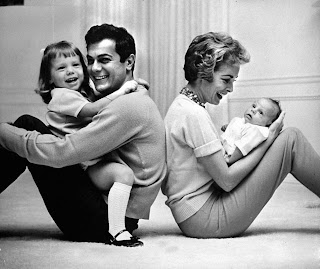


Curtis was married five times. His first wife was actress Janet Leigh, to whom he was married from 1951 to 1962, and with whom he fathered actresses Kelly and Jamie Lee Curtis. On July 8, 2010, Curtis, who suffered from chronic obstructive pulmonary disease (COPD), was hospitalized in Las Vegas after suffering an asthma attack during a book signing engagement in Henderson, Nevada and died at his Henderson, Nevada home on September 29, 2010, of a cardiac arrest. He is buried at Palm Memorial Park in Las Vegas, Nevada.

Who died on this date:


On June 3, 1977, director Roberto Rossellini died. He was born on May 8, 1906 in Rome. His father built the first cinema in Rome, granting his son an unlimited free pass; the young Rossellini started frequenting the cinema at an early age. When his father died, he worked as a sound maker for films and for a certain time he experienced all the accessory jobs related to the creation of a film, gaining competence in each field.

In 1937, Rossellini made his first documentary, Prélude à l'après-midi d'un faune. After this essay, he was called to assist Goffredo Alessandrini in making Luciano Serra pilota, one of the most successful Italian films of the first half of the 20th century. In 1940 he was called to assist Francesco De Robertis on Uomini sul Fondo. His first feature film, La nave bianca (1942) was sponsored by the audiovisual propaganda centre of Navy Department and is the first work in Rossellini's "Fascist Trilogy", together with Un pilota ritorna (1942) and Uomo dalla Croce (1943). To this period belongs his friendship and cooperation with Federico Fellini and Aldo Fabrizi. When the Fascist regime ended in 1943, just two months after the liberation of Rome, Rossellini was already preparing Roma città aperta (Rome, Open City 1945). Fellini assisted on the script and Fabrizi playing the role of the priest, while Rossellini self-produced. Most of the money came from credits and loans, and film had to be found on the black market. This dramatic film was an immediate success. Rossellini had started now his so-called Neorealistic Trilogy, the second title of which was Paisà (1946), produced with non-professional actors, and the third, Germany, Year Zero (1948), sponsored by a French producer and filmed in Berlin's French sector. In Berlin also, Rossellini preferred non-actors, but he was unable to find a face he found "interesting"; he placed his camera in the center of a town square, as he did for Paisà, but was surprised when nobody came to watch.

In 1948, Rossellini received a letter from a famous foreign actress proposing collaboration:

Dear Mr. Rossellini,

I saw your films Open City and Paisan, and enjoyed them very much. If you need a Swedish actress who speaks English very well, who has not forgotten her German, who is not very understandable in French, and who in Italian knows only "ti amo", I am ready to come and make a film with you.

Ingrid Bergman


With this letter began one of the best known love stories in film history, with Bergman and Rossellini both at the peak of their careers. Their first collaboration was Stromboli terra di Dio (1950). This affair caused a great scandal in some countries (Bergman and Rossellini were both married to other people); the scandal intensified when Bergman became pregnant. Rossellini and Bergman had three children, Isabella Rossellini (actress & model) and her twin, Ingrid Isotta, as well as a son Roberto Ingmar Rossellini. Europa '51 (1952) and Journey to Italy (1953), La paura (1954) and Giovanna d'Arco al rogo (1954) were the other films on which they worked together.


In 1957, Jawaharlal Nehru, the Indian Prime Minister at the time, invited him to India to make the documentary India and put some life into the floundering Indian Films Division. Though married to Bergman, he had an affair with Sonali Das Gupta, a screenwriter, who was helping develop vignettes for the film. Given the climate of the 1950’s this led to a huge scandal in India as well as Hollywood. Nehru had to ask Rossellini to leave. Rossellini's films after his early Neo-Realist films, particularly his films with Ingrid Bergman were commercially unsuccessful, though Journey to Italy is well regarded in some quarters. Roberto Rossellini died of a heart attack on June 3, 1977 in Rome, Italy and is buried at the Cimitero Monumentale del Verano in Rome, Italy.


http://www.michaelthomasbarry.com/, author of "Fade to Black: Graveside Memories of Hollywood Greats, 1927-1950"