Showing posts with label Chicago mobsters. Show all posts

Wednesday, March 19, 2014

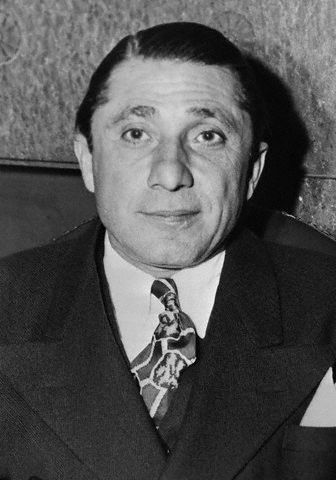
Mobster Frank "The Enforcer" Nitti Committed Suicide - 1943


On March 19, 1943, mobster Frank “The Enforcer” Nitti, one of Al Capone’s henchmen and later front man for the Chicago Outfit, committed suicide after being indicted for extorting money from Hollywood producers. Born on January 27, 1886 in Italy, Nitti came to the United States in 1893, at the age of 7. His family settled in Brooklyn, but Frank moved to Chicago by 1920. Using his barbershop as a meeting place for small-time hoods, Nitti started fencing stolen jewelry, attracting the attention of big-time mobster Johnny Torrio and one of his strongmen, Al Capone. Nitti joined Al Capone's criminal empire, called the Chicago Outfit. Rising quickly in the organization, he displayed a talent for business, becoming known for efficiently smuggling Canadian whiskey into Chicago speakeasies, which served as distribution points throughout the city. By the mid-1920s, Nitti was a high ranking member of the Capone mob.

Although his nickname was "The Enforcer," Frank Nitti rarely took part in violent activities, delegating them instead to underlings. In 1931, he and Capone were convicted of tax evasion and sent to prison, but Nitti received an 18-month sentence, while Capone received 11 years. Severely claustrophobic, Nitti served his time in extreme discomfort, an experience that would mark him until the day he died.  When Nitti was released in 1932, the media dubbed him the new boss of Capone's gang, although it has since been revealed that Nitti was the face, and perhaps brains of the Chicago Outfit, while another man, Paul Ricca, was its true leader. Aiming to take down the Outfit's presumed head, in December 1932, Chicago policemen raided Nitti's office, shooting him in the back and neck. Nitti survived, and during the trial it was revealed that one of the officers had been paid $15,000 to kill Nitti. Needing to reinvent the Outfit after the end of Prohibition, Nitti turned the Outfit's attention to the labor unions and, even more, Hollywood. But in 1943, Nitti and many top members of the Chicago Outfit were indicted for extorting money from some of the largest movie studios in Hollywood, including MGM, Paramount, and 20th Century Fox, and they faced stiff sentences if convicted. Because of his claustrophobia, enhanced during his first prison term, Nitti feared the idea of a long confinement. So, faced with life in prison or perhaps murder by fellow Outfit members to keep him quiet, Nitti shot himself in the head on March 19, 1943, in a train yard, near his home in Riverside, Illinois.
 
 
Michael Thomas Barry is the author of numerous books that include the award winning, Murder and Mayhem 52 Crimes that Shocked Early California, 1849-1949 (2012, Schiffer Publishing). The WINNER of the 2012 International Book Awards and a FINALIST in the 2012 Indie Excellence Book Awards for True Crime. The book can be purchased at Amazon through the following link:    


Visit Michael's website for more information: www.michaelthomasbarry.com

Wednesday, October 17, 2012

Al Capone is Sentenced for Tax Evasion - 1931


Just announced - Murder & Mayhem 52 Crimes that Shocked Early California 1849-1949 was awarded an "honorable mention" in the 2012 Halloween Book Festival in the general non-fiction category. www.halloweenbookfestival.com


On this date in 1931, gangster Al Capone is sentenced to 11 years in prison for tax evasion.

 
Alphonse Gabriel Capone was born in Brooklyn, New York in 1899 to Italian immigrants. He was expelled from school at 14, joined a gang and earned his nickname "Scarface" after being sliced across the cheek during a fight. By 1920, Capone had moved to Chicago, where he was soon helping to run crime boss Johnny Torrio's illegal enterprises, which included alcohol-smuggling, gambling and prostitution. In 1925 Torrio retired and Capone was put in charge of the organization. Prohibition, which outlawed the brewing and distribution of alcohol and lasted from 1920 to 1933, proved extremely lucrative for bootleggers and gangsters like Capone, who raked in millions from his underworld activities. Capone was at the top of the F.B.I.'s "Most Wanted" list by 1930, but he avoided long stints in jail until 1931 by bribing city officials, intimidating witnesses and maintaining various hideouts. He became Chicago's crime kingpin by wiping out his competitors through a series of gangland battles and slayings, including the infamous St. Valentine’s Day Massacre in 1929, when Capone's men gunned down seven rivals. This event helped raise Capone's notoriety to a national level. Among Capone's enemies was federal agent Elliot Ness, who led a team of officers known as "The Untouchables" because they couldn't be corrupted. Ness and his men routinely broke up Capone's bootlegging businesses, but it was tax-evasion charges that finally stuck and landed Capone in prison in 1931. Capone began serving his time at the U.S. Penitentiary in Atlanta, but amid accusations that he was manipulating the system and receiving cushy treatment, he was transferred to the maximum-security lockup at Alcatraz Island in San Francisco Bay. He got out early in 1939 for good behavior, after spending his final year in prison in a hospital, suffering from syphilis. Plagued by health problems for the rest of his life, Capone died in 1947 at age 48 at his home in Palm Island, Florida.

Tuesday, October 9, 2012

Chicago Mobster Roger Touhy Escapes from Prison - 1942

On this date in 1942, Chicago bootlegger Roger "The Terrible" Touhy escapes from prison by climbing the guard's tower.

 
Touhy, who had been framed for kidnapping by his bootlegging rivals with the help of corrupt Chicago officials, was serving a 99-year sentence for a kidnapping he did not commit. He was recaptured a couple of months later. The son of a police officer, Touhy had served in the Navy during World War I and later set up a trucking business in the Chicago suburbs. But when business faltered during Prohibition, Touhy realized he could earn a better living through bootlegging. Along with his partner, Matt Kolb, Touhy began brewing his own beer and shipping it to speakeasies all over the state. His beer was widely considered the finest available at the time. When organized crime leader  Al Capone heard about Touhy's operation, he wanted to get in on the action, but since Capone was not really familiar with the environment outside of the city, Touhy had an advantage. Touhy shouted orders to his fictional gang over the telephone when Capone's henchmen showed up. Capone's men reported back that Touhy was not someone to mess with, but Capone was undeterred. He kidnapped Matt Kolb, forcing Touhy to cough up $50,000 for his release. When he ordered Kolb's murder in 1931 anyway, the feud escalated. Capone helped to orchestrate a fake kidnapping, which he pinned on Touhy. In 1933, with assistance from Daniel "Tubbo" Gilbert, a Chicago police officer known as "the richest cop in the world." Touhy was convicted for abducting con man Jake Factor and sent to prison. Shortly after his escape in 1942, Touhy was returned to prison. But his attorneys successfully persuaded an appeals court that the Factor kidnapping was a hoax, and Touhy was finally released in 1959. Three weeks later, as he was entering his sister's home, Touhy was hit by several shotgun blasts. Before he died, he was reported to have said, "I've been expecting it. The bastards never forget." No arrests were ever made.