Showing posts with label assassinations. Show all posts

Monday, June 23, 2014

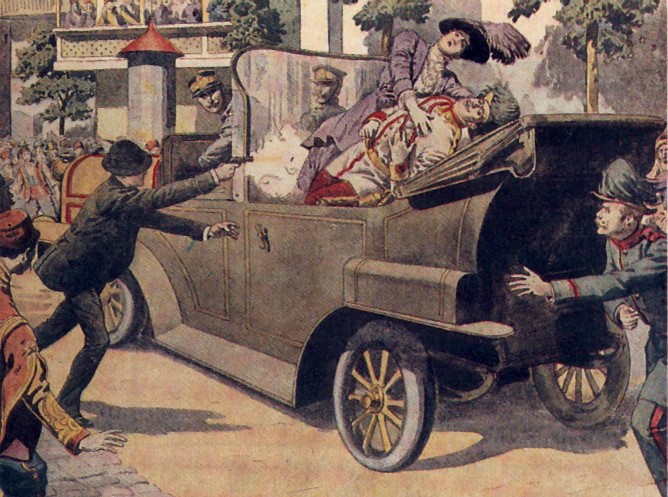
Archduke Franz Ferdinand was Assassinated (June 28, 1914)


This week in crime history – June 23-29: Klaus Fuchs, Soviet spy was released from a British prison (June 23, 1959); Yale professor David Gelernter was injured by a bomb sent by the Unabomber (June 24, 1993); Congress passes the Mann Act (June 25, 1910); Serial killer Melvin Rees claims another victim (June 26, 1957); Spanish Conquistador Francisco Pizarro was assassinated (June 26, 1541); Mormon leader Joseph Smith was murdered (June 27, 1844); Austrian Archduke Franz Ferdinand was assassinated (June 28, 1914); Boston doctor Dirk Greineder was found guilty of murdering his wife (June 29, 2001).

Highlighted crime of the week -

On June 28, 1914, Archduke Franz Ferdinand of Austria and his wife Sophie were shot to death by a Bosnian Serb nationalist during an official visit to the Bosnian capital of Sarajevo. The killings sparked a chain of events that led to the outbreak of World War I by early August. Five years later on the same day, Germany and the Allied Powers signed the Treaty of Versailles, officially marking the end of World War I.

The archduke traveled to Sarajevo in June 1914 to inspect the imperial armed forces in Bosnia and Herzegovina, annexed by Austria-Hungary in 1908. The annexation had angered Serbian nationalists, who believed the territories should be part of Serbia. A group of young nationalists hatched a plot to kill the archduke during his visit to Sarajevo, and after some missteps, 19-year-old Gavrilo Princip was able to shoot the royal couple at point-blank range, while they traveled in their official procession.

The assassination set off a rapid chain of events, as Austria-Hungary immediately blamed the Serbian government for the attack. Because Russia supported Serbia, Austria asked for assistance from Germany. On July 28, Austria-Hungary declared war on Serbia, and the fragile peace between Europe's great powers collapsed, beginning the devastating conflict now known as World War I.

After more than four years of bloodshed, the Great War ended on November 11, 1918, after Germany, the last of the Central Powers, surrendered to the Allies. The Versailles Treaty, signed on June 28, 1919, tragically failed to achieve its objective of eliminating global war. U.S. President Woodrow Wilson’s grand dreams of an international peace-keeping organization faltered when put into practice as the League of Nations. Even worse, the harsh terms imposed on Germany, the war's biggest loser, led to widespread resentment of the treaty and its authors in that country, a resentment that would culminate in the outbreak of World War II twenty years later.
 
 
Michael Thomas Barry is the author of numerous books that include the award winning, Murder and Mayhem 52 Crimes that Shocked Early California, 1849-1949 (2012, Schiffer Publishing). The book was the WINNER of the 2012 International Book Awards and a FINALIST in the 2012 Indie Excellence Book Awards for True Crime.  

Visit the author's website for more information: www.michaelthomasbarry.com. The book can be purchased from Amazon through the following link:   

Monday, April 14, 2014

Abraham Lincoln was Shot - 1865


On this date in crime history – April 14, 1865, President Abraham Lincoln was shot by actor John Wilkes Booth at Ford’s Theater. After shooting the president Booth shouted, "Sic semper tyrannis! (Ever thus to tyrants!) The South is avenged," as he jumped onto the stage and fled on horseback. Lincoln died the next morning. Booth was a well-known actor who was particularly loved in the South. During the war, he stayed in the North and became increasingly bitter. Along with friends Samuel Arnold, Michael O'Laughlin, and John Surratt, Booth conspired to kidnap Lincoln and deliver him to the South. 

On March 17, along with George Atzerodt, David Herold, and Lewis Paine, the group met in a Washington bar to plot the abduction of the president three days later. However, when the president changed his plans, the scheme was scuttled. Shortly afterward, the South surrendered to the Union and the conspirators altered their plan. They decided to kill Lincoln, Vice President Andrew Johnson, and Secretary of State William Seward. 

On April 14, Atzerodt backed out of his part to kill Johnson. Upset, Booth went to drink at a saloon near Ford's Theater. At about 10 p.m. he walked into the theater and up to the president's box. Lincoln's guard, John Parker, was not there because he had gotten bored with the play, Our American Cousin, and left his post to get a drink. Booth easily slipped in and shot the president in the back of the head. The president's friend, Major Rathbone, attempted to grab Booth but was slashed by Booth's knife. Booth injured his leg badly when he jumped to the stage to escape, but he managed to hobble outside to his horse. Meanwhile, Lewis Paine forced his way into William Seward's house and stabbed the secretary of state several times before fleeing. Booth rode to Virginia with David Herold and stopped at the home of Dr. Samuel Mudd, who placed splints on Booth's legs. They hid in a barn on Richard Garrett's farm as thousands of Union troops combed the area looking for them. The other conspirators were captured, except for John Surratt, who fled to Canada. 

When federal troops finally caught up with Booth and Herold on April 26, they gave them the option of surrendering before the barn was burned down. Herold decided to surrender, but Booth remained in the barn as it went up in flames. Booth was then shot and killed in the burning barn by Corporal Boston Corbett. On July 7, George Atzerodt, Lewis Paine, David Herold, and John Surratt's mother, Mary, were hanged in Washington. The execution of Mary Surratt is believed by some to have been a miscarriage of justice. Although there was proof of Surratt’s involvement in the original abduction conspiracy, it is clear that her deeds were minor compared to those of the others who were executed. Her son John was eventually tracked down in Egypt and brought back to trial, but he managed, with the help of clever lawyers, to win an acquittal.
 
 
Michael Thomas Barry is a columnist for www.crimemagazine.com and is the author of numerous books that include the award winning, Murder and Mayhem 52 Crimes that Shocked Early California, 1849-1949 (2012, Schiffer Publishing). The WINNER of the 2012 International Book Awards and a FINALIST in the 2012 Indie Excellence Book Awards for True Crime. Visit the author’s website for more information: www.michaelthomasbarry.com   

His book can be purchased at Amazon through the following link: 
Amazon - http://www.amazon.com/Murder-Mayhem-Shocked-California-1849-1949/dp/0764339680/ref=la_B0035CPN70_1_3?ie=UTF8&qid=1361552464&sr=1-3

Saturday, September 14, 2013

President William McKinley died - 1901


On September 14, 1901, President William McKinley succumbs to gunshot wounds inflicted by an assassin on September 6th. According to witnesses, McKinley's last words were those of the hymn "Nearer My God to Thee." McKinley was shaking hands in reception line at the Pan-American Exhibition in Buffalo, New York, when a 28-year-old anarchist named Leon Czolgosz approached him with a gun concealed in a handkerchief in his right hand.
McKinley assumed the handkerchief was an attempt by Czolgosz to hide a physical defect and kindly reached for the man's left hand. Czolgosz moved in close to the president and fired two shots into McKinley's chest. The assassin was attempting to fire a third bullet into the stricken president when aides wrestled him to the ground. McKinley suffered one superficial wound to the sternum and another bullet dangerously entered his abdomen. He was rushed into surgery and seemed to be on the mend by September 12th, but later that day, his condition worsened. On September 14th, McKinley died from gangrene that had remained undetected in the internal wound. Vice President Theodore Roosevelt was sworn in as president immediately following McKinley's death. Czolgosz confessed to his crime, but remained unrepentant. At his execution on October 29, 1901, his last words were "I killed the president because he was the enemy of the good people, the working people."
 
Michael Thomas Barry is a columnist for CrimeMagazine.com and author of Murder & Mayhem 52 Crimes that Shocked Early California 1849-1949. The book can be purchased from Amazon through the following link: