Showing posts with label William Shakespeare. Show all posts

Friday, May 11, 2018

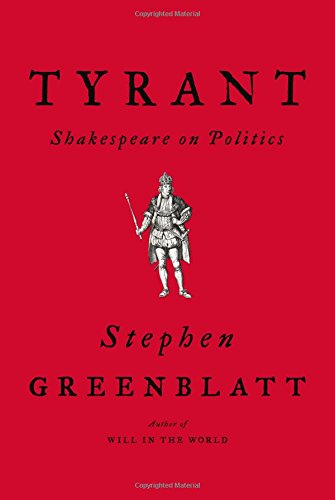
Review of Tyrant: Shakespeare on Politics by Stephen Greenblatt

Image of Tyrant: Shakespeare on Politics

Author: Stephen Greenblatt
Release date: May 8, 2018
Publisher: WW Norton
Page: 208
Buy from Amazon - https://www.amazon.com/Tyrant-Shakespeare-Politics-Stephen-Greenblatt/dp/0393635759/ref=sr_1_1?ie=UTF8&qid=1526059320&sr=8-1&keywords=stephen+greenblatt

As Queen Elizabeth I’s 50-year reign over England entered its latter years, a controversial and gifted playwright entered the theater scene and dove head first into the social causes, psychological roots, and cruel consequences of tyranny. In plays like Richard III, Macbeth, and King Lear, William Shakespeare probed the psyche of his characters rampant lust for absolute power and the long-term effects on its calamitous execution.

He asked himself, “How is it possible for a whole country to fall into the hands of a tyrant?” Under what circumstances . . . do such cherished institutions, seemly deep-rooted and impregnable, suddenly prove fragile?
Esteemed traditions were crumbling, political loyalties were blurred, severe economic woes fueled anti-elitist resentment, average citizens willingly allowed wanton lies and partisan vindictiveness to permeate everyday life. Shakespeare was captivated by all aspects of these societal crises and calamities. With intelligent, clever and poignant awareness, Shakespeare zeroed in on the childish mindsets and ravenously egotistical desires of these firebrands—and the cynicism and unscrupulousness of the numerous enablers and associates who surrounded them. Any of this sound familiar?

In Tyrant: Shakespeare on Politics, Pulitzer Prize and National Book Award winning author Stephen Greenblatt explores the legendary playwright’s unique perceptions and insights of wicked and immoral rulers. A world renowned Shakespearian expert, Greenblatt is a professor of Humanities at Harvard University and has written numerous books that include The Swerve, Will in the World, and The Rise and Fall of Adam and Eve.

Greenblatt’s perceptive analysis and expert examination of the various tyrannical figures in Shakespeare’s works has an eerie parallel and peculiar familiarity to current political trends. Using the central characters of Shakespeare’s plays the author compellingly and captivatingly scrutinizes the conditions that permit the rise of despotic, dictatorial, and high-handed leaders.

Through skillful and knowledgeable use of quotes and excerpted passages, he provides a brilliant illustration of how intimidation and strong-arm tactics can suppress any political resistance and why anyone would “be drawn to a leader manifestly unsuited to govern, someone dangerously impulsive or viciously conniving or indifferent to the truth.”

Although Greenblatt does not specifically name or discuss any current political personalities, it can be naturally implied that contemporary figures are the main target of comparisons. But make no mistake, this book is essentially about President Donald J. Trump and his brand of populism, or at least what the author believes Shakespeare would have thought about him personally and his political movement.

Tyrant is a clever and well written interpretation of how our current political environment compares to Shakespeare’s most controversial and legendary works. Truth be told, Trump is no tyrant like Macbeth or Richard III, but Greenblatt’s compelling conversations on those who assist and are complicit to dictators is particularly illuminating.

Overall, this book is full of surprising and shocking insights that examine character politics and the exploitation of authoritarianism as it pertains to literary criticism. A must read for any student of classic literature, history, and politics.

Michael Thomas Barry is a staff writer for the New York Journal of Books.

This review first appeared at the New York Journal of Booms on May 8, 2018 - https://www.nyjournalofbooks.com/book-review/tyrant

Wednesday, April 23, 2014

William Shakespeare was Born - 1564


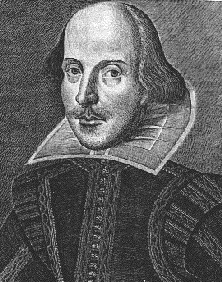
On this date in English literary history – April 23, 1564, and according to legend, the great English dramatist and poet William Shakespeare was born in Stratford-on-Avon. It is impossible to be certain the exact day on which he was born, but church records show that he was baptized on April 26, and three days was a customary amount of time to wait before baptizing a newborn. Shakespeare's date of death is conclusively known, however: it was April 23, 1616. He was 52 years old and had retired to Stratford three years before.

Although few plays have been performed or analyzed as extensively as the 38 plays ascribed to William Shakespeare, there are few surviving details about the playwright's life. This lack of biographical information is due primarily to his station in life; he was not a noble, but the son of John Shakespeare, a leather trader and the town bailiff. The events of William Shakespeare's early life can only be assembled from official records, such as baptism and marriage records. He probably attended the grammar school in Stratford, where he would have studied Latin and read classical literature. He did not go to university but at age 18 married Anne Hathaway, who was eight years his senior and pregnant at the time of the marriage. Their first daughter, Susanna, was born six months later, and in 1585 William and Anne had twins, Hamnet and Judith. Hamnet, Shakespeare's only son, died 11 years later, and Anne Shakespeare outlived her husband, dying in 1623. Nothing is known of the period between the birth of the twins and Shakespeare's emergence as a playwright in London in the early 1590s, but unfounded stories have him stealing deer, joining a group of traveling players, becoming a schoolteacher, or serving as a soldier in the Low Countries.

The first reference to Shakespeare as a London playwright came in 1592, when a fellow dramatist, Robert Greene, wrote derogatorily of him on his deathbed. It is believed that Shakespeare had written the three parts of Henry VI by that point. In 1593, Venus and Adonis was Shakespeare's first published poem, and he dedicated it to the young Henry Wriothesley, the 3rd Earl of Southampton. In 1594, having probably composed, among other plays, Richard III, The Comedy of Errors, and The Taming of the Shrew, he became an actor and playwright for the Lord Chamberlain's Men, which became the King's Men after James I's ascension to the throne in 1603. The company grew into England's finest, in no small part because of Shakespeare, who was its principal dramatist. It also had the finest actor of the day, Richard Burbage, and the best theater, the Globe, which was located on the Thames' south bank. Shakespeare stayed with the King's Men until his retirement and often acted in small parts.

By 1596, the company had performed the classic Shakespeare plays Romeo and Juliet, Richard II, and A Midsummer Night's Dream. That year, John Shakespeare was granted a coat of arms, a testament to his son's growing wealth and fame. In 1597, William Shakespeare bought a large house in Stratford. In 1599, after producing his great historical series, the first and second part of Henry IV and Henry V, he became a partner in the ownership of the Globe Theatre. The beginning of the 17th century saw the performance of the first of his great tragedies, Hamlet. During the next decade, Shakespeare produced such masterpieces as Othello, King Lear, Macbeth, and The Tempest. In 1609, his sonnets, probably written during the 1590s, were published. The 154 sonnets are marked by the recurring themes of the mutability of beauty and the transcendent power of love and art. Shakespeare died in Stratford-on-Avon on April 23, 1616.
 
 
Michael Thomas Barry is the author of numerous books that include Literary Legends of the British Isles : The Lives and Burial Places of 50 Great Writers. Visit the author's website for more information - www.michaelthomasbarry.com
 
His book can be purchased at Amazon through the following link:
 

Saturday, June 29, 2013

William Shakespeare's "The Globe Theater" burns to the ground - 1613


On June 29, 1613, the Globe Theater, where most of William Shakespeare's plays debuted burned to the ground. The Globe was built by Shakespeare's acting company, the Lord Chamberlain's Men, in 1599 from the timbers of London's very first permanent theater, Burbage's Theater, built in 1576. Before James Burbage built his theater, plays and dramatic performances were ad hoc affairs, performed on street corners and in the yards of inns. However, the Common Council of London, in 1574, started licensing theatrical pieces performed in inn yards within the city limits. To escape the restriction, actor James Burbage built his own theater on land he leased outside the city limits. When Burbage's lease ran out, the Lord Chamberlain's men moved the timbers to a new location and created the Globe. Like other theaters of its time, the Globe was a round wooden structure with a stage at one end, and covered balconies for the gentry. The galleries could seat about 1,000 people, with room for another 2,000 "groundlings," who could stand on the ground around the stage. The Lord Chamberlain's men built Blackfriars Theater in 1608, a smaller theater that seated about 700 people, to use in winter when the open-air Globe wasn't practical.
Michael Thomas Barry is the author of Literary Legends of the British Isles. The book can be purchased from Amazon through the following links: 


Thursday, June 20, 2013

Playwright and author Nicholas Rowe was born - 1674


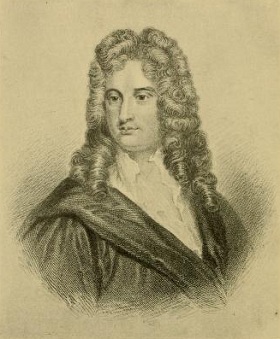
Author and playwright Nicholas Rowe was born on June 20, 1674 in Little Barford, Bedfordshire, England. He was an English writer who was the first to attempt a critical edition of the works of William Shakespeare. Rowe succeeded Nahum Tate as Poet Laureate in 1715 and was also the foremost 18th-century English tragic dramatist, doing much to assist the rise of the domestic tragedy. His early plays such as The Ambitious Step-Mother (1700) and Tamerlane (1702) are reminiscent of John Dryden’s heroic drama in their pomp and bluster but contain elements presaging the spirit of sentiment that characterizes The Fair Penitent (1703) and later works. Rowe composed The Tragedy of Jane Shore (1714) in imitation of Shakespeare’s style, as he did The Tragedy of the Lady Jane Grey (1715). His only comedy, The Biter (1704), was a failure. In The Works of Mr. William Shakespeare; Revis’d and Corrected, Rowe essentially followed the fourth folio edition of 1685, although he claimed to have arrived at the text by comparing several editions. He did, however, restore some passages in Hamlet, Romeo and Juliet, Henry V, and King Lear from early texts. He did add biographical information on the life of Shakespeare that, although composed for the most part of inaccurate information, remained the basis for all Shakespeare biographies until the early 19th century. He died on December 6, 1718 and was buried at Westminster Abbey.


Michael Thomas Barry is the author of Literary Legends of the British Isles. The book can be purchased from Amazon through the following links:

Amazon - http://www.amazon.com/Literary-Legends-British-Isles-Writers/dp/0764344382/ref=sr_1_2?ie=UTF8&qid=1370974389&sr=8-2&keywords=michael+thomas+barry

Amazon UK - http://www.amazon.co.uk/Great-Britains-Literary-Legends-Writers/dp/0764344382/ref=sr_1_2?ie=UTF8&qid=1370974426&sr=8-2&keywords=michael+thomas+barry


Friday, April 26, 2013

William Shakespeare was baptized - 1564


English playwright and poet William Shakespeare was baptized on April 26, 1564. The actual date of his birth is not known. He is widely regarded as the greatest writer in the English language and the world's preeminent dramatist. He is often called England's national poet and the "Bard of Avon.” His extant works, including some collaboration; they consist of about 38 plays, 154 sonnets, and two long narrative poems. His plays have been translated into every major living language and are performed more often than those of any other playwright. 

Shakespeare was born and raised in Stratford-upon-Avon. At the age of 18, he married Anne Hathaway, with whom he had three children. Between 1585 and 1592, he began a successful career in London as an actor, writer, and theater owner. He appears to have retired to Stratford around 1613 at age 49, where he died on April 23, 1616. 

Few records of Shakespeare's private life survive, and there has been considerable speculation about such matters since his death. Shakespeare produced most of his known work between 1589 and 1613. His early plays were mainly comedies and histories, genres he raised to the peak of sophistication and artistry by the end of the 16th century. He then wrote mainly tragedies until about 1608, including Hamlet, King Lear, Othello, and Macbeth, which are considered some of the finest works in the English language. In his last phase, he wrote tragicomedies, also known as romances, and collaborated with other playwrights.
Many of his plays were published in editions of varying quality and accuracy during his lifetime. In 1623, John Heminges and Henry Condell, two friends and fellow actors of Shakespeare, published the First Folio, a collected edition of his dramatic works that included all but two of the plays now recognized as Shakespeare's. It was prefaced with a poem by Ben Jonson, in which Shakespeare is hailed, presciently, as "not of an age, but for all time." 

Shakespeare was a respected poet and playwright in his own day, but his reputation did not rise to its present heights until the 19th century. The Romantics, in particular, acclaimed Shakespeare's genius, and the Victorians worshiped Shakespeare with a reverence. In the 20th century, his work was repeatedly adopted and rediscovered by new movements in scholarship and performance. His plays remain highly popular today and are constantly studied, performed, and reinterpreted in diverse cultural and political contexts throughout the world.


Michael Thomas Barry is the author of Great Britain’s Literary Legends. The book can be purchased from Amazon through the following links:

Amazon - http://www.amazon.com/Great-Britains-Literary-Legends-Writers/dp/0764344382/ref=sr_1_2?ie=UTF8&qid=1366995131&sr=8-2&keywords=michael+thomas+barry

Amazon UK - http://www.amazon.co.uk/Great-Britains-Literary-Legends-Writers/dp/0764344382/ref=sr_1_7?ie=UTF8&qid=1366995182&sr=8-7&keywords=michael+thomas+barry