Showing posts with label Percy Bysshe Shelley. Show all posts

Friday, August 30, 2013

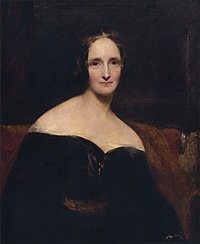
English author Mary Shelley was born - 1787


English author Mary Shelley was born on August 30, 1787 in London. She was the author of the Gothic novel, Frankenstein (1818) and was the second wife of poet Percy Bysshe Shelley. She was the daughter of two intellectual heavyweights, feminist Mary Wollstonecraft and social reformer William Godwin. She eloped with Percy Shelley in 1814 and they spent their life together in Europe. Their married life was brief and tragic. Mary had several miscarriages and two of her children died, then Percy drowned in 1822 when he was 29 years old. While in Geneva with her husband and the poet Lord Byron, Mary Shelley wrote Frankenstein, now a classic of Gothic Romanticism. The story of a reckless doctor who creates a living monster from the body parts of the dead, Frankenstein was published in 1818 and has since become the inspiration for many other stories and films. After her husband's death, Mary returned to England, where she continued her career as an author and editor of her husband's poems and prose. Her other novels include Valperga (1823), The Last Man (1826) and Lodore (1835). From 1839, she suffered from headaches and bouts of paralysis, which sometimes prevented her from reading and writing. On February 1, 1851, at Chester Square, London, she died at the age of fifty-three from what her physician suspected was a brain tumor. She was buried at St. Peter’s Church, Bournemouth.
 
Michael Thomas Barry is the author of Literary Legends of the British Isles. The book can be purchased from Amazon through the following links:

Monday, July 8, 2013

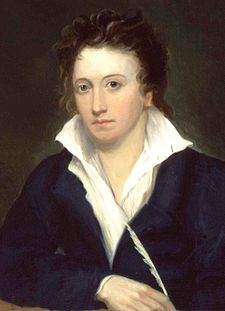
Poet Percy Bysshe Shelley died - 1822


Poet Percy Bysshe Shelley died on July 8, 1822 in a ship wreck off of the coast of Italy. He was born on August 4, 1792 near Horsham in Sussex. His father was a member of parliament and young Shelley was educated at Eton and at Oxford University. There he began to read radical writers such as Tom Paine and William Godwin. In 1811, he was expelled for his contribution to a pamphlet supporting atheism.
Shelley then eloped to Scotland with 16-year-old Harriet Westbrook. The resulting scandal caused a serious rift with his family. Harriet and Shelley had two children, but soon separated. In 1813, Shelley published his first serious work, Queen Mab.

In 1814, Shelley fell in love with Mary, the 16-year-old daughter of writers William Godwin (a friend of Shelley's) and Mary Wollstonecraft. The couple traveled together in Europe and spent the summer of 1816 at Lake Geneva with Lord Byron. Shelley wrote poetry and Mary conceived the idea for her novel Frankenstein. In December 1816, Shelley and Mary were married; just a few weeks after Harriet had drowned herself. In 1818, Shelley took his family to Italy where they moved from city to city. Two of the Shelley's children died and Mary herself suffered a nervous breakdown. Nonetheless, this was the most productive period of his life. Poems included Prometheus Unbound (1818-19) and Adonais (1821), inspired by the death of his friend and fellow poet John Keats. In April 1822, the Shelley’s settled on the Bay of Lerici on the north-western Italian coast. On July 8th, Shelley was returning from visiting his friends Lord Byron and James Leigh Hunt when his boat overturned and he was drowned. He was cremated and his ashes were buried at the Protestant Cemetery in Rome, where Keats was also buried.


Michael Thomas Barry is the author of Literary Legends of the British Isles. The book can be purchased from Amazon through the following links:


Friday, April 19, 2013

British poet George Lord Byron died - 1824


On April 19, 1824, British poet George Lord Byron died in what is now Greece. He had traveled there to support the Greek struggle for independence from Turkey. Byron's scandalous history, exotic travels, and flamboyant life made such an impression on the world that the term "Byronic" was coined to mean romantic, arrogant, dark, and cynical. He was one of the leading figures in the Romantic movement. Byron was born on January 22, 1788 in Aberdeen, Scotland. His clubfoot and his impoverished environment made his childhood difficult, but at age 10 he inherited his great uncle's title. He attended Harrow, then Trinity College, Cambridge, where he ran up enormous debts and pursued passionate relationships with women and men. His first published volume of poetry, Hours of Idleness (1807), was not well received by critics, especially in Scotland, and his second published work, English Bards and Scotch Reviewers (1809), attacked the English literary establishment.

After attaining a Master's degree in 1809, he traveled in Portugal, Spain, and the Near East for two years. His experiences fed into his later works, including Childe Harold's Pilgrimage (1812), which brought him almost instant acclaim in England. As he said at the time, he "awoke one morning and found myself famous." His poetry, manners, fashion, and tastes were widely imitated. In 1815, he married Anne Isabella Milbanke, and the couple had a daughter, August Ada. The marriage quickly foundered, and the couple legally separated. By this time, scandal had broken out over Byron's suspected incest with his half-sister, Augusta Leigh, and he was ostracized from society and forced to flee England in 1816. He settled in Geneva, near Percy Bysshe Shelley and his wife, Mary Wollstonecraft Shelley. There, he became intimately involved with Mary's half-sister, Claire Clairmont, who bore his daughter Allegra in January 1817. Byron moved to Venice that year and entered a period of wild debauchery. 

In 1819, he began an affair with the Countess Teresa Guiccioli, the young wife of an elderly count, and the two remained attached for many years. Byron, always an avid supporter of liberal causes and national independence, supported the Greek war for independence. He joined the cause in Greece, training troops in the town of Missolonghi. On February 15, 1824, he fell ill, and the usual remedy of bloodletting weakened him further. He made a partial recovery, but in early April he caught a violent cold which therapeutic bleeding, insisted on by his doctors, aggravated. It is suspected this treatment, carried out with unsterilized medical instrumentation, may have caused him to develop sepsis. He developed a violent fever, and died on April 19, 1824. Byron is buried at the Church of St. Mary Magdalene in Hucknall, Nottinghamshire, England.


Michael Thomas Barry is the author of Great Britain’s Literary Legends. The book can be purchased from Amazon through the following links:
Amazon - http://www.amazon.com/Great-Britains-Literary-Legends-Writers/dp/0764344382/ref=sr_1_2?ie=UTF8&qid=1366385247&sr=8-2&keywords=michael+thomas+barry

Amazon UK - http://www.amazon.co.uk/Great-Britains-Literary-Legends-Writers/dp/0764344382/ref=sr_1_1?ie=UTF8&qid=1366385295&sr=8-1&keywords=michael+thomas+barry