
This week (November 10 – 16) in crime history – British
au pair Louise Woodward’s murder sentence was reduced to involuntary manslaughter
in death of Mathew Eappen (November 10, 1997); Police find first of six bodies
buried in the yard of elder care home owner Dorthea Puente in Sacramento,
California (November 11, 1988); Scott Peterson was convicted of murdering his
wife and unborn child (November 12, 2004); Police search home of airline bombing
suspect John Graham (November 13, 1955); Ivan Boesky pleaded guilty to insider
trading (November 14, 1986); Serial killer Ed Gein claimed final victim
(November 16, 1957).
Highlighted Crime
of the Week -
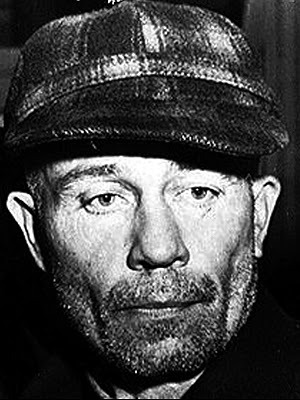
On November 16, 1957, infamous serial killer Edward Gein
claimed his final victim, Bernice Worden of Plainfield, Wisconsin. His grave
robbing, necrophilia, and cannibalism gained national attention, and may have provided
inspiration for the characters of Norman Bates in Alfred Hitchcock’s Psycho and serial killer Buffalo Bill in
The Silence of the Lambs. Gein was a
quiet farmer who lived in rural Wisconsin with an extremely domineering mother.
After she died in 1945, he began studying anatomy, and started stealing women's
corpses from local cemeteries. In 1954, Gein shot and killed tavern owner Mary
Hogan, piled the body onto a sled, and dragged it home.
On November 16, Gein robbed Bernice Worden at the local
hardware store she owned and killed her. Her son, a deputy sheriff, discovered
his mother's body and became suspicious of Gein, who was believed to be
somewhat odd. When authorities searched Gein's farmhouse, they found a
horrifying scene: organs were in the refrigerator, a heart sat on the stove,
and heads had been made into soup bowls. Apparently, Gein had kept various
organs from his grave digging and murders as keepsakes and for decoration. He
had also used human skin to upholster chairs. Though it is believed that he
killed others during this time, Gein only admitted to the murders of Worden and
Hogan. In 1958, Gein was declared insane and sent to the Wisconsin State
Hospital in Mendota, where he remained until his death in 1984.
Check back every
Monday for a new installment of “This Week in Crime History.”
Michael Thomas Barry is the author of six nonfiction
books that includes the award winning Murder
and Mayhem 52 Crimes that Shocked Early California (2012). Visit Michael’s
website www.michaelthomasbarry.com
for more information. His book can be purchased from Amazon through the
following link:


