
On this date in crime history – April 15, 1920 a
paymaster and a security guard are killed during a mid-afternoon armed
robbery of a shoe company in South Braintree, Massachusetts. Out of this crime
grew one of the most famous trials in American history and a landmark case in
forensic crime detection. Both Fred Parmenter and Alessandro Berardelli were
shot several times as they attempted to move the payroll boxes of their New
England shoe company. The two armed thieves, identified by witnesses as
"Italian-looking," fled in a Buick. The car was found abandoned in
the woods several days later. Through evidence found in the car, police
suspected that a man named Mike Boda was involved. However, Boda was one step
ahead of the authorities, and he fled to Italy. Police did manage to catch
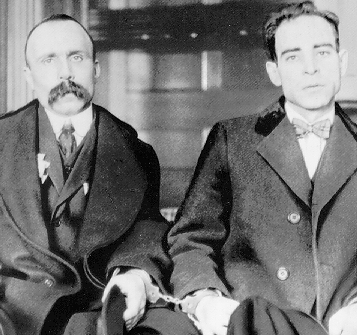
Boda's colleagues, Nicola Sacco and Bartolomeo Vanzetti, who were each carrying
loaded weapons at the time of their arrest. Sacco had a .32 caliber handgun, the
same type as was used to kill the security guards and bullets from the same
manufacturer as those recovered from the shooting. Vanzetti was identified as a
participant in a previous robbery attempt of a different shoe company.
Sacco and Vanzetti were anarchists, believing that social
justice would come only through the destruction of governments. In the early 1920s,
mainstream America developed a fear of communism and radical politics that
resulted in anti-immigrant hysteria. Sacco and Vanzetti, recognizing the uphill
battle ahead, tried to put this fear to their advantage by drumming up support
from the left wing with claims that the prosecution was politically motivated.
Millions of dollars were raised for their defense by the radical left around
the world. The American embassy in Paris was even bombed in response to
the Sacco-Vanzetti case; a second bomb intended for the embassy in Lisbon was
intercepted. The well-funded defense put up a good fight, bringing forth nearly
100 witnesses to testify on the defendants' behalf. Ultimately, eyewitness
identification wasn't the crucial issue; rather, it was the ballistics tests on
the murder weapon. Prosecution experts, with rather primitive instruments,
testified that Sacco's gun was the murder weapon. Defense experts claimed just
the opposite. In the end, on July 14, 1921, Sacco and Vanzetti were found
guilty; they were sentenced to death. However, the ballistics issue refused to
go away as Sacco and Vanzetti waited on death row. In addition, a jailhouse
confession by another criminal fueled the controversy. In 1927, Massachusetts
Governor A. T. Fuller ordered another inquiry to advise him on the clemency request
of the two anarchists. In the meantime, there had been many scientific advances
in the field of forensics. The comparison microscope was now available for new
ballistics tests and proved beyond a doubt that Sacco's gun was indeed the
murder weapon.
Sacco and Vanzetti were executed in August 1927, but even
the new evidence didn't completely suppress the controversy. In October 1961,
and again in March 1983, new investigations were conducted into the matter, but
both revealed that Sacco's revolver was indeed the one that fired the bullet
and killed the security guards. On August 23, 1977, Massachusetts Governor
Michael Dukakis issued a proclamation that Sacco and Vanzetti had not received
a fair trial.

Michael Thomas
Barry is a columnist for www.crimemagazine.com and is the author of numerous books that include the award winning, Murder
and Mayhem 52 Crimes that Shocked Early California, 1849-1949 (2012,
Schiffer Publishing). The WINNER of the 2012 International Book Awards and a
FINALIST in the 2012 Indie Excellence Book Awards for True Crime. Visit the
author’s website for more information: www.michaelthomasbarry.com
His book
can be purchased at Amazon through the following
link:
Amazon - http://www.amazon.com/Murder-Mayhem-Shocked-California-1849-1949/dp/0764339680/ref=la_B0035CPN70_1_3?ie=UTF8&qid=1361552464&sr=1-3

