Showing posts with label what happened on this date in literary history. Show all posts

Friday, January 30, 2015

Zane Grey was Born - January 31, 1872


This week (January 30-February 5) in literary history – Frank Nelson Doubleday died (January 30, 1934); Zane Grey was born (January 31, 1872); A.A. Milne died (January 31, 1956); Lord Byron’s The Corsair was published (February 1, 1814); Mary Shelley died (February 1, 1851); Alexandre Dumas married Ida Ferrier (February 1, 1840); James Joyce was born (February 2, 1882); Samuel Clemens began using the pen name Mark Twain (February 2, 1863); James Joyce’s Ulysses was published in Paris (February 2, 1922); John Keats becomes aware that he has tuberculosis (February 3, 1820); James Fenimore Cooper’s The Last of the Mohicans was published (February 4, 1826); Norton Simon was born (February 5, 1907); Thomas Carlyle died (February 5, 1881).

Highlighted story of the week -

On January 31, 1872, prolific western novelist Zane Grey and author of Riders of the Purple Sage, was born in Zanesville, Ohio. The son of a successful dentist, Grey enjoyed a happy and solid upper-middle-class childhood, marred only by occasional fistfights with boys who teased him about his unusual first name, Pearl. (Grey later replaced it with his mother's maiden name, Zane.) A talented baseball player as teen, Grey caught the eye of a scout for the University of Pennsylvania baseball team, who convinced him to study there. In 1886, he graduated with a degree in dentistry and moved to New York to begin his practice.

Grey's interest in dentistry was half-hearted at best, and he did not relish the idea of replicating his father's safe but unexciting career path. Searching for an alternative, Grey decided to try his hand at writing; his first attempt was an uninspiring historical novel about a family ancestor. At that point, Grey might well have been doomed to a life of dentistry, had he not met Colonel C. J. "Buffalo" Jones in 1908, who convinced Grey to write Jones' biography. More importantly, Jones took him out West to gather material for the book, and Grey became deeply fascinated with the people and landscape of the region.

Grey's biography of Jones debuted in 1908 as The Last of the Plainsmen to little attention, but he was inspired to concentrate his efforts on writing historical romances of the West. In 1912, he published the novel that earned him lasting fame, Riders of the Purple Sage. Like the equally popular Owen Wister novel, The Virginian (1902), the basic theme of Riders revolves around the transformation of a weak and effeminate easterner into a man of character and strength through his exposure to the culture and land of the American West. Grey's protagonist, the Ohio-born Bern Venters, spends several weeks being tested by the rugged canyon country of southern Utah before finding his way back to civilization. Venters, Grey writes, "had gone away a boy-he had returned a man." Though Riders of the Purple Sage was Grey's most popular novel, he wrote 78 other books during his productive career, most of them Westerns. He died on October 23, 1939 at the age of 67, from heart failure at his estate in Altadena, California. After his death, Grey's works continued to be extraordinarily popular for decades to come.

Check back every Friday for a new installment of “This Week in Literary History.”

Michael Thomas Barry is the author of six nonfiction books that include the award winning Literary Greats of the British Isles and the recently published America’s Literary Legends. Visit Michael’s website www.michaelthomasbarry.com for more information. His books can be purchased from Amazon through the following links:
 
http://www.amazon.com/Literary-Legends-British-Isles-Writers/dp/0764344382/ref=sr_1_2?ie=UTF8&qid=1422638767&sr=8-2&keywords=michael+thomas+barry&pebp=1422638785487&peasin=764344382


http://www.amazon.com/Americas-Literary-Legends-Burial-Writers/dp/0764347020/ref=sr_1_1?ie=UTF8&qid=1422638767&sr=8-1&keywords=michael+thomas+barry&pebp=1422638807355&peasin=764347020

Friday, July 26, 2013

Author Aldous Huxley was born - 1963


Author Aldous Huxley was born on July 26, 1894 in Godalming, Surrey, England. He is best known for his novels including Brave New World and a wide-ranging output of essays, Huxley also edited the magazine Oxford Poetry, and published short stories, poetry, travel writing, film stories and scripts. He spent the later part of his life in the United States, living in Los Angeles from 1937 until his death. Huxley later became interested in spiritual subjects such as parapsychology, mysticism, and Universalism. He is also well known for his use of psychedelic drugs. By the end of his life Huxley was widely acknowledged as one of the preeminent intellectuals of his time. He died on November 22, 1963 in Los Angeles, California, and his death was overshadowed by the assassination of President John F. Kennedy. 


Michael Thomas Barry is the author of Literary Legends of the British Isles. The book can be purchased from Amazon through the following links:


Monday, February 11, 2013

Voltaire returns to Paris from exile - 1778


On February 11, 1778, some 300 people visit Voltaire following his return to Paris. Voltaire had been in exile for 28 years. Born Francois-Marie Arouet to middle-class parents in Paris in 1694, Voltaire began to study law as a young man but quit to become a playwright. He made a name for himself with classical tragedies and also wrote poetry. In 1717, he was arrested for his satirical poem La Henriade, which attacked politics and religion. Voltaire spent nearly a year in the Bastille as punishment. Voltaire's time in prison failed to dry up his satirical pen. In 1726, government disapproval of his work forced him to flee to England. He returned several years later and continued to write plays. In 1734, his Lettres Philosophiques criticized established religions and political institutions, and he was again forced to flee Paris. He retreated to the region of Champagne, where he lived with his mistress and patroness, Madame du Chételet. In 1750, he moved to Berlin on the invitation of Frederick II of Prussia and later settled in Switzerland, where he wrote his best-known work, Candide. After 28 years, he returned to Paris and was greeted by hundreds of intellectuals. He died in Paris in May 1778.


Michael Thomas Barry is the author of Great Britain’s Literary Legends. His book can be pre-ordered at Amazon through the following links:


Thursday, February 7, 2013

French Writer Emile Zola is brought to Trial - 1898


On February 7, 1898, French writer Emile Zola is brought to trial for libel for "J'Accuse," his newspaper editorial attacking the French army over the Dreyfus affair. On January 13, Zola had published his editorial in the newspaper L'Aurore. The letter exposed a military cover-up regarding Alfred Dreyfus. Dreyfus, a French army captain, had been accused of espionage in 1894 and sentenced in a secret military court-martial to imprisonment in a South American penal colony. Two years later, evidence of Dreyfus' innocence surfaced, but the army suppressed the information. Zola's letter exposed the military's mistaken conviction. Zola was a well-known writer who had published his first story collection more than three decades earlier. A high school dropout, he had worked in the sales department of a major French publisher, who encouraged his writing and published his first book. He became one of the most famous writers in France with the publication of his 1877 hit, The Drunkard, part of his 20-novel cycle exploring the lives of two families. Zola's letter provoked national outrage on both sides of the issue, among political parties, religious organizations, and others. Supporters of the military sued Zola for libel. He was convicted and sentenced to one year's imprisonment, but he fled France. In 1899, Dreyfus was pardoned, but for political reasons he was not exonerated until 1906. Shortly after Dreyfus' pardon, Zola returned to France, where he died in 1902. 
 
 
Michael Thomas Barry is the author of Great Britain’s Literary Legends. The book can be ordered from Amazon through the following links: 


Monday, February 4, 2013

James Fenimore Cooper's "The Last of the Mohicans" is Published - 1826


On February 4, 1826, James Fenimore Cooper’s classic The Last of the Mohicans is published. One of the earliest distinctive American novels, the book is the second of the five-novel series called the "Leather-stocking Tales." Cooper was born in 1789 in New Jersey and moved the following year to the frontier in upstate New York, where his father founded frontier-town Coopersville. Cooper attended Yale but joined the Navy after he was expelled for a prank. When Cooper was about 20, his father died, and he became financially independent. Having drifted for a decade, Cooper began writing a novel after his wife challenged him to write something better than he was reading at the moment. His first novel, Precaution, modeled on Jane Austen, was not successful, but his second, The Spy, influenced by the popular writings of Sir Walter Scott, became a bestseller, making Cooper the first major American novelist. The story was set during the American Revolution and featured George Washington as a character. He continued to write about the American frontier in his third book, The Pioneer, which featured backcountry scout Natty Bumppo, known in this book as "Leather-stocking." The character, representing goodness, purity, and simplicity, became tremendously popular, and reappeared, by popular demand, in five more novels, known collectively as the "Leather-stocking Tales." The second book in the series, The Last of the Mohicans, is still widely read today. The five books span Bumppo's life, from coming of age through approaching death. Cooper died in 1851.  
 
 
Michael Thomas Barry is the author of Great Britain’s Literary Legends. His book can be pre-ordered from Amazon thought the following links: 


Saturday, February 2, 2013

Irish Novelist James Joyce is Born - 1882


Legendary Irish novelist James Joyce was born on February 2, 1882 in Dublin, Ireland, the eldest of 10 children. His father, a cheerful ne'er-do-well, will eventually go bankrupt. Joyce attended Catholic school and University College in Dublin. A brilliant scholar, he learned Dano-Norwegian in order to read the plays of Henrik Ibsen in the original language. In college, he began a lifetime of literary rebellion, self-publishing an essay rejected by the school's literary magazine adviser. After graduation, Joyce moved to Paris. He planned to become a doctor to support himself while writing, but soon gave up his medical studies. He returned to Dublin to visit his mother's deathbed and remained to teach school and work odd jobs. On June 16, 1904, he met Nora Barnacle, a lively uneducated woman with whom he fell in love. He convinced Nora to return to Europe with him. The couple settled in Trieste, where they had two children, and then in Zurich. Joyce struggled with serious eye problems, undergoing 25 operations for various troubles between 1917 and 1930. In 1914, he published The Dubliners. The following year, his novel Portrait of the Artist as a Young Man brought him fame and won him several wealthy patrons, including Edith Rockefeller. In 1918, the American journal Little Review began to serialize Ulysses, Joyce's revolutionary stream-of-consciousness novel. However, the U.S. Post Office stopped the publication's distribution in December of that year on the grounds that the novel was obscene. Sylvia Beach, owner of the bookstore Shakespeare and Co. in Paris, published the novel herself in 1922, but it was banned in the United Kingdom and in the U.S. until 1933. Joyce's last novel, Finnegan's Wake, was published in 1939, and two years later before the author’s death in January 1941. 
 
 
Michael Thomas Barry is the author of Great Britain’s Literary Legends. The book can be pre-ordered from Amazon through the following links: 


Friday, February 1, 2013

Lord Byron's "The Corsair" is Published - 1814


On February 1, 1814, Lord Byron's "The Corsair" is published and sells some 10,000 copies on its first day in print. The poem was one of several gloomy works he produced at a time when he was engaged in several ill-fated love affairs. George Gordon Byron was born in Aberdeen, Scotland, in 1788 and was raised in poverty.  At age 10, he inherited his great uncle's title and became Lord Byron. He attended Harrow, then Trinity College, Cambridge, where he ran up enormous debts. His first published volume of poetry, Hours of Idleness (1807), was panned by critics, especially in Scotland, and his second published work, English Bards and Scotch Reviewers (1809), attacked the British literary establishment. fter taking his master's degree in 1809, he traveled in Portugal, Spain, and the Near East for two years. His wanderings inspired his poetic work Childe Harold's Pilgrimage (1812), which won him almost instant acclaim in England. In 1815, he married Anne Isabella Milbanke, and the couple had a daughter, August Ada. The marriage quickly foundered, and the couple legally separated. By this time, scandal had broken out over Byron's suspected incest with his half-sister, Augusta Leigh. He was ostracized from society and forced to flee England in 1816. He settled in Geneva, near Percy Bysshe Shelley and his wife, Mary Wollstonecraft Shelley. There, he became intimately involved with Mary's half-sister, Claire Clairmont, who bore his daughter Allegra in January 1817. In 1819, he began an affair with the Countess Teresa Guiccioli, the young wife of an elderly count, and the two remained attached for many years. Byron, always an avid proponent of liberal causes and national independence, supported the Greek war for independence. He joined the cause in Greece, training troops in the town of Missolonghi, where he died on April 19, 1824. 
 
 
Michael Thomas Barry is the author of Great Britain’s Literary Legends. The book can be pre-ordered from Amazon through the following links: 


Thursday, January 31, 2013

Author Zane Grey is Born - 1872


On January 31, 1872 author Zane Grey, author of Riders of the Purple Sage, is born in Zanesville, Ohio. He was the son of a successful dentist, who enjoyed a happy and solid upper-middle-class childhood, marred only by occasional fistfights with boys who teased him about his unusual first name, Pearl. (Grey later replaced it with his mother's maiden name, Zane.) A talented baseball player as teen, Grey caught the eye of a scout for the University of Pennsylvania college team, who convinced him to study there. In 1886, he graduated with a degree in dentistry and moved to New York to begin his practice. 

Grey's interest in dentistry was half-hearted at best, and he did not relish the idea of replicating his father's safe but unexciting career path. Searching for an alternative, Grey decided to try his hand at writing; his first attempt was an uninspiring historical novel about a family ancestress. At that point, Grey might well have been doomed to a life of dentistry, had he not met Colonel C. J. "Buffalo" Jones in 1908, who convinced Grey to write Jones' biography. More importantly, Jones took him out West to gather material for the book, and Grey became deeply fascinated with the people and landscape of the region. 

Grey's biography of Jones debuted in 1908 as The Last of the Plainsmen to little attention, but he was inspired to concentrate his efforts on writing historical romances of the West. In 1912, he published the novel that earned him lasting fame, Riders of the Purple Sage. Like the equally popular Owen Wister novel, The Virginian (1902), the basic theme of Riders revolves around the transformation of a weak and effeminate easterner into a man of character and strength through his exposure to the culture and land of the American West. Though Riders of the Purple Sage was Grey's most popular novel, he wrote 78 other books during his prolific career, most of them Westerns. He died in 1939, but Grey's work continued to be extraordinarily popular for decades to come and by 1955, his books had sold more than 31 million copies around the world. With the possible exception of Riders, today Grey's books are little read, and most modern readers find them insufferably pompous, moralizing, and sentimental. Nonetheless, Grey played a pivotal role in creating the Western genre that, in the hands of more recent authors like Louis L'Amour, continues to charm many dedicated fans. 
 
 
Michael Thomas Barry is the author of Great Britain’s Literary Legends. The book can be pre-ordered from Amazon through the following links – 


Wednesday, January 30, 2013

Author Michael Dorris is Born - 1945


On this date in 1945, Native American novelist Michael Dorris is born in Louisville, Kentucky. Dorris met his wife, Louise Erdrich, at a poetry reading at Dartmouth, where he had founded a Native American studies program. Dorris had already adopted three Native American children in the early 1970s, one of the first single men in America to be allowed to adopt children. The couple married in 1981 and had three children of their own. The two writers struggled to support their growing family until Erdrich won the Nelson Algren fiction prize in 1982, with an award of $5,000. The pair edited each others' work and sometimes wrote together. Both writers began winning prestigious awards for their work, stating with the Algren prize and accelerating after Erdrich's first novel Love Medicine (1984) won the National Book Critics Award. Dorris published A Yellow Raft in Blue Water, a novel about three generations of Native American women, in 1987. The Broken Cord (1989), his nonfiction account of his adoptive son's fetal alcohol syndrome, became a bestseller and was made into a TV movie starring Jimmy Smits in 1992. His second novel, The Cloud Chamber, was published in 1997. Erdrich and Dorris, who dedicated all their books to each other, seemed the perfect literary couple until Dorris took his own life in 1997. It turned out that he was facing allegations of child abuse, which he denied. Meanwhile, he had become deeply depressed, and the couple's marriage was unraveling. Erdrich had secretly been separated from Dorris for more than a year at the time of his death.


Michael Thomas Barry’s book Great Britain’s Literary Legends: The Lives and Burial Places of 50 Great Writers can be pre-ordered from Amazon through the following links:

Amazon - http://www.amazon.com/Great-Britains-Literary-Legends-Writers/dp/0764344382/ref=ntt_at_ep_dpt_3

Amazon UK - http://www.amazon.co.uk/Great-Britains-Literary-Legends-Writers/dp/0764344382/ref=sr_1_9?ie=UTF8&qid=1359482251&sr=8-9


Tuesday, January 29, 2013

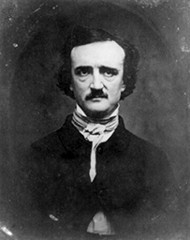
Edgar Allan Poe's "The Raven" is Published - 1845


Edgar Allan Poe's famous poem "The Raven," beginning "Once upon a midnight dreary," is published on January 29, 1845 in the New York Evening Mirror. Poe's dark and macabre work reflected his own tumultuous and difficult life. Born in Boston in 1809, Poe was orphaned at age three and went to live with the family of a Richmond, Virginia, businessman. Poe enrolled in a military academy but was expelled for gambling. He later studied briefly at the University of Virginia. In 1827, he self-published a collection of poems. Six years later, his short story "MS Found in a Bottle" won $50 in a story contest. He edited a series of literary journals, including the Southern Literary Messenger in Richmond starting in 1835, and Burton's Gentleman's Magazine in Philadelphia, starting in 1839. Poe's excessive drinking got him fired from several positions. His macabre work, often portraying motiveless crimes and intolerable guilt that induces growing mania in his characters, was a significant influence on such European writers as Charles Baudelaire, Stephane Mallarme, and even Dostoyevsky. 
 
 
Michael Thomas Barry’s book Great Britain’s Literary Legends: The Lives & Burial Places of 50 Great Writers can be pre-ordered from Amazon through the following links: